Showing posts with label Patanjali. Show all posts

Tuesday, January 4, 2022

Surrender

There is no getting past it on the spiritual path. Eventually we have to surrender. Let go. Give up. 

What are we surrendering and what are we surrendering to? The mind wants answers to these questions, as if it will make a difference. (It won't. But let's look at it anyway.)

Patañjali points to surrender in the fifth niyama of the Yoga Sutra. Reading the fourth and the fifth niyamas together gives more.

II.44 svādhyāyad iṣṭa-devatā-samprayogaḥ

II.45 samādhi-siddhir īśvara-praṇidhānāt

44. From study [of scripture], a connection with one's deity of choice is established.

45. From submission to God comes the perfection of samādhi. (Bryant translations 2009)

In modern yoga schools, particularly in western culture, svādhyāya is often translated as "self study". It is not a wrong translation, it does mean that, but in practice, in the cultural context in which Patañjali was penning his sutras, it definitely meant scriptural study, which teach about the "self " in a spiritual sense. And in these two sutras it is quite clear that Patañjali is a theist. There IS a God, or Gods, since our "deity of choice" is to emerge from scriptural study (44), and then submission to that deity (īśvara) yields the fruits of yoga (45). So for Patañjali we are surrendering to our deity of choice. 

(Non-dual translator Swami Venkatesananda renders īśvara-praṇidhānā as "surrender to the indwelling omni-presence.)

What we are surrendering to is the larger than ego sense of self, call it god or universal Consciousness, Awareness, that which unfolds the entire universe into being and takes it all back again. That primordial hum or energy or om that is the fabric of the universe! But you cannot think this. No amount

The work to be done on the spiritual path is a process of stripping away all that we think we know about ourselves, all the stories we have about ourselves, and everything else. Stories are held in the ego's domain. And the ego is yet another story, the story of there being a separate me at all. 

The Tantric practice of deha śuddhi internalises this process in its ritual absorption. The body is visualised as having an internal fire into which the practitioner offers all those stories, knowing that all that is true will survive, but all that is untrue will perish. It is a purifying fire. (Learn this and other tantric practices from living teachers please, descriptions like this in blogs and books are not instructions!)

In other meditative work you can take a story, say a deeply rooted belief in one's innate inadequacy, and really hold it up for examination, not with the mind alone, but with the body: When you take this belief to be true, where and how do you feel it in the body? We do this in iRest where we are also encouraged to not only dialogue with a single belief but also to try on alternatives. What would be an alternative to this belief? Find a memory that would support that belief, or imagine an incident in your life which would support that belief, and feel that in your body. It doesn't take long before you find the deeply rooted belief loosening.

Here is the irony: ego is doing all this spirituality stuff to strip away our stories. In the end ego has to give up, so profoundly, it even gives up its attachment to its own existence story!

Surrender is saying yes, totally, to the truth, and nothing but the truth.

Surrender is a profound letting go. Letting go of all the stories you have about yourself and everything, every image or idea you have about yourself. I am good, I am worth it, I am not good enough, the lot.


See also my poem Surrender to the Beloved.


Sunday, December 26, 2021

Embracing embodiment

 Let us bless
The imagination of the Earth.
That knew the early patience
To harness the mind of time,
Waited for the seas to warm, 
Ready to welcome the emergence
Of things dreaming of voyaging
Among the stillness of the land.

So begins John O'Donahue's "In Praise of the earth". I turn to it as I contemplate the bottom-most tattva on the Map of Meditation, earth element. Not lowly for all that it sits there at the bottom, Tattva 36 as numbered from the top down, but remember, it is number one on the return journey! 

(Read my previous post "The map of meditation")

No, not lowly, but the fullest expression of the amazing unfolding of the universe. When the element of earth is manifest, creation is complete.

Think about this. Embodiment, to have a body, is to inhabit earth element.  Only earth element contains the totality of everything, from Śiva Consciousness to the ultimate of creation. As embodied creatures we are that.

Sage Patanjali, in forming the sutras on Śauca, Purity, displays a distaste for the embodied state which was common in many Indian spiritual traditions.

By cleanliness, one [develops] distaste for one's body and the cessation of contact with others. (Yoga Sutra II:40, Bryant tr.)

The original commentator, Vyasa, whom many scholars now surmise was one and the same person as the author of the sutra, observes that the yogin realises that the body can never be clean, no matter how much it is washed, and therefore he no longer would wish to contact with other bodies which is bound to be more polluting.  Sex is off the agenda, for sure!

This attitude arises when you believe that you are somehow separate from the body, believing that it is just simply part of that "other", Prakṛti, when one is attempting to realise fully that one is pure spirit, Puruṣa.

In Advaita Vedanta also, the body is dismissed as not real, the real is Puruṣa, now called Ātman, which is none other than Brahman, Universal Consciousness. There is nothing else. So it too is body-denying, shunning the pleasure and experience of embodiment.

The View of Non-dual Śaiva Tantra is different. There is nothing in your experience of the embodied state that is not a valid place to explore your Essence Nature. Right - down - to - earth!

Further lines of the O'Donohue poem are pertinent:

Let us thank the Earth
That offers ground for home
And holds our feet firm
To walk in space open
To infinite galaxies.

And:

Let us remember within us
The ancient clay,
Holding the memory of seasons,
The passion of the wind,
The fluency of water,
The warmth of fire,
the quiver touch of the sun
And shadowed sureness of the moon.

We thank and praise the whole of experience as anything at all can  and does illuminate the whole of Consciousness which is the author of everything.

So we take the body, and experience it fully. We let go of the concepts we might have about it and simply experience it.  It is sensation. Sometimes loud, sometimes soft. Sometimes it sings, sometimes it cries, but we do not judge, it simply is.  What is your experience of the body, without any thought about it? When we are fully experiencing the whole of what is here by fully entering into the felt sense of the body we are embracing the entirety of all 36 tattvas at once. 

If we divorce ourselves from that full felt experience, we do not fully embrace all of what is here. This not only creates a schism in ourselves where we are unable to fully process feelings and emotions but it also says, I cannot be awakened to the whole of my truth until I can be rid of this body.  And this tradition says, no, you can be awakened in an embodied form. Accept and embrace everything.

So being fully embodied, fully embracing the felt sense of the body with all that it presents, helps us to become more psychologically integrated but also helps us towards our spiritual awakening. Whoopee, let’s fully sense our body.

The Vijñāna-bhairava-tantra has many practices that invite us to be fully embodied, with the promise that this may be the experience that catapults us to Awakening, such as when receiving a body piercing, fully enter into the pain; when embracing a friend not seen for a long time sense into that embrace; swinging on a swing, through the soothing motion one knows the Divine.

Yoga Nidra always includes a rotation of awareness around the body. It springs from the practice of nyasa, a ritual of touching parts of the body in a rotation together with the intonation of specific mantras. The literal touching and the mantra are replaced by mentally touching named parts of the body with attention and then moving it on to the next point.

In iRest® this is a fully developed experiencing of the body as sensation, letting go of cognition and simply experiencing as sensation.

Movement practice such as asana, can be practiced as an athletic exercise, true, as in a vigorous vinyasa, however all asana practice is an opportunity to practice being fully embodied, sensing into the full sensation of the body, moving a bit more slowly perhaps to be more fully present. Somatics was not designed as an Awakening sadhana, but it is so mindful it too offers such an opportunity.  All our movement practices, with the right approach, can be "Embodiment practice", an opportunity to  connect to all the elements, right down to Earth.

Do not forget the simple act of living as an opportunity too. Walk barefoot and feel the earth, the grass, the sand, the rock, beneath the feet and between the toes. Put your hands in the dirt by gardening. 

What will you do to embrace yourself as Earth element today?

The Blue Marble is a famous photograph of the Earth taken on December 7, 1972, by the crew of the Apollo 17 spacecraft en route to the Moon at a distance of about 29,000 kilometres (18,000 mi). It shows Africa, Antarctica, and the Arabian Peninsula.


Friday, January 29, 2021

The third limb

Head into most modern yoga classes and what you will meet is a lot of āsana and the merest smattering of other yoga practices such as prāṇāyāma, meditation and so on.
In his Yoga Sutras, Patañjali delineates eight limbs of yoga. (Naughty aside: Thus yoga is either an octopus or an arachnid.) Modern scholars have pointed out that the Yoga Sutras did not have much of a following in earlier times, but were revived in the modern era. They are now required reading in nearly all reputable modern postural yoga teacher trainings. The irony is that while such trainings emphasise the postures of yoga, the Yoga Sutras say very little. Indeed, I have often heard it pointed out that Patañjali is only referring to establishing a comfortable posture for sitting.
The more I learn though, the more I question anything I have ever been told, read or believed.
Most translations of the Yoga Sutras are just that, a translation of the pithy verses of condensed Sanskrit, usually accompanied by a commentary by the translator. These are the translations that we usually look at in our yoga teacher trainings.
I was intrigued, therefore, to read "A Concise Histiography of Classical Yoga Philosophy" (2013) by Phillip Maas, in which a case is made that the original commentary, attributed to Vyāsa, is actually also by the same author as the Yoga Sutras, and that we should be treating the sutras and the commentary as one work, we could call the Pātañjala Yogaśāstra. In fact very early authors do just that, as early as 650CE. Maas's argument has convinced other scholars as well.
Unfortunately, English translations of the sutras plus commentary are hard to find. The Edwin Bryant translation of the sutras (2009) does cite the Vyāsa commentary a lot but the only version I have found that gives an actual translation is Yoga Philosophy of Patañjali by Swāmi Hariharānanda Āraṇya tr P.N. Mukerji (1983). So I turned to it to see what Vyāsa/Patañjali says of the most famous of the four sutras on āsana, II:46, sthira-sukham āsanam - The posture should be steady and comfortable.
Actually, that is Bryant's translation, much better than Hariharānanda/Mukerji's rather awkward "Motionless and Agreeable form (of staying) is Āsana (Yogic Posture)".
Here, in full, is the translation of the Vyāsa commentary:

They are as follows: - Padmāsana, Virāsana, Bhadrāsana, Svastikāsana, Dandāsana, Soprāśraya, Paraṅka, Krauñcha (heron)-niṣadana, Hasti (elephant) niṣadana, Uṣṭra (camel)- niṣadana, Sama-saṁsthāna. When these postures can be held comfortably, they are called (Yogic) Āsanas.
Bryant also notes that Vyāsa knew of more postures since he put etc. at the end of his list, an etc not included by Hariharānanda.


Padmāsana is the lotus pose that we know today, feet on the opposite thighs. Virāsana however is what we might call half lotus.

Bhadrāsana seems to be what we now call Baddhakonāsana.

Svastikāsana is called the same today, auspicious pose, toes tucked in.

Dandāsana also has not changed over the millenia but did have the stipulation that the feet be firmly together.
Soprāśraya may hearten you. It means support pose. a yoga-paṭṭika is to be used, only we are not too sure what that is, but for sure it is some kind of prop, perhaps a board or stool, or maybe a band, as in the statue below, which is from the 18th century, but it is not unsual to see such figures using a yoga strap as support, in temple carvings from even earlier periods.

Paraṅka is the same as śavāsana, lying down with arms by the side. 

Bryant says that the ancient commentators recommended studying the relevent creature's seated position to learn Krauñcha-niṣadana, Hasti-niṣadana, and Uṣṭra-niṣadana, and I could not say if that is the same as current day poses. 

Sama-saṁsthāna or level pose is standing, or what we might call Tadāsana or Samasthitiḥ.
The ancient commentators (after Vyāsa) are clear that the postures are to be held without motion with the posture straight, torso neck and head in alignment. So no vinyasa here, or just a one minute hold!
So, interest definitely engaged I proceed to the second of the four sutras on āsana. II:47 prayatna-śaithilyānanta-samāpattibhyām and Bryant's translation - [Such posture should be attained] by the relaxation of effort and by absorption in the infinite. And Vyāsa's commentary:
By relaxation of the body Āsana is perfected; this stops shaking of the limbs (which is an obstacle to Samādhi). Or, a mind fixed on the infinite brings about perfection (Siddhi) of the Āsana.
Bryant summarises the commentaries saying: "The essential idea is that by the practice of āsana, the body should be so relaxed that the yogī ceases to be conscious of it at all, and the mind can be thus directed toward meditation without any bodily distraction."
So, despite the inclusion of a few more than expected postures, the idea is still to hold them long, hold them still and relax into them until you can do it with no effort. Then meditate.
The third sutra on āsana, II:48 tato dvandvānabhighātaḥ - From this one is not afflicted by the dualities of the opposites. (Bryant).
When perfection in Āsana is attained, the devotee is not affected by the opposite conditions like heat and cold etc.
The point here is that the body disappears in the practitioner's perception, becomes the void, says Hariharānanda.
So if you thought finding more postures than expected made the Yoga Sutras more relevant to modern postural yoga, be disabused. We are all full of body positivity in our modern yoga rooms, but Patanjali was having none of that. Remember what he said about the first of the niyamas, Śauca, purity? II:40 śaucāt svānga-jugupsā parair asaṁsargaḥ - By cleanliness, one [develops] distaste for one's body and the cessation of contact with others. (Bryant). No, he hasn't had a change of heart between sutras 40 and 48!
There is one more sutra in the section on āsana, posture. II:49 tasmin sati śvāsa-praśvāsayor gati-vicchedaḥ prāṇāyāmaḥ - When that [āsana] is accomplished, prāṇāyāmaḥ, breath control, [follows]. This consists of the regulation of the incoming and outgoing breath. (Bryant)
So, there we have it, a link verse, leaving āsana and moving onto the next limb. Though Bryant does note the grammatical construction that tells us that there is a sequential progress through the limbs, and the accomplishing of the mastery of posture should be underway before progressing to breath-control.
In summary, we can still say that what Patañjali/Vyāsa has to say about āsana is still worlds away from modern postural practice. But what an interesting journey of discovery it has been.

Thursday, August 15, 2019

Beyond duality


Vitarkabādhane pratikpakṣabhāvanam*
Yoga Sutra 2:33


Translations:

When the mind is disturbed by passions one should practise pondering over their opposites.
Swami Satyananda Saraswati

In order to exclude from the mind questionable things, the mental calling up of those things that are opposite is efficacious for their removal.
William Q. Judge

When distracted by wayward or perverted rationalization, suitable counter measures should be adopted to keep away or remove such obstacles, especially by the contemplation of the other point of view.
Swami Venkatesananda

When negative feelings restrict us, the opposite should be cultivated.
Alistair Shearer


When disturbed by negative thoughts, opposite [positive] ones should be thought of. This is pratipaksha bhavana.
Swami Satchidananada

Cultivating of opposites

The phenomenal world is a world of opposites: Hot/cold, big/little, smart/stupid, black/white, me/you. It is a world of dualistic opposites. It has to be so. Whatever we are experiencing now, the opposite is also here, or at the very least, waiting in the wings. Our thinking is in opposites, our feeling and emoting is in opposites. 

Yoga Sutra 2:33 recognises that we become embroiled in disturbing cognitions and feelings and counsels the cultivation of the opposite. You might ask, if the opposite can always be here too, why do I get caught up in the most uncomfortable of the pair, in distress instead of in comfort? 

This has to do with the way our brain has evolved to keep us safe.  We have a negative bias.  Better that we mistake a stick for a snake than a snake for a stick. What happens though is that we get a bit trapped in the negativity and begin to  suffer.  We believe it, so we suffer.

In this age of the wonders of imaging the brain scientists have now shown how cultivating gratitude for example can change the very structures of the brain, growing the hippocampus and shrinking the amygdala. Cultivation of gratitutde is an example of cultivating the opposite.  When doom and gloom is all around, practice noticing what there is to be grateful for.

Welcoming opposites

The practice becomes even more powerful when we also practice welcoming both sides of the pair, not rejecting that discomforting side, not clinging on to that more comfortable side, but being open to them both.

In the practice of iRest® yoga nidra meditation we do this, moving between the two sides of the pair, welcoming both, whether it is a feeling in the body, such as hot/cold, an emotion and its feeling in the body, such as sad/happy, or a thought or belief, such as I am stupid/I am smart. We always notice how they feel in the body and go between those feelings, not just summoning them as a thought.  What does it feel like to believe I am stupid? What does it feel like to believe I am smart?

Both together

It is when we reach the point where we hold them both together that the really big power moment comes. It is not a merging, but both here together, both opposites at the same time. 

Wow! The resolution opens up to a state that is beyond opposites.  This is a sense of open, welcoming, Presence that is full of equanimity. How so?

Moving beyond duality to the simple way things are

This embodied form incudes all the thoughts, emotions, and every perception that we have, including the me thought. This embodied form is constrained by thought into believing in separation, a me and a you. It is in this state that the opposites arise.

The mind of thoughts is so powerful, and we are so habituated to its illusions, that we need a few tricks if we are to see beyond it and experience another Reality. And one of those little tricks is this work in opposites. When we hold these two opposite constructs of the mind at the same time, we may be able to "see" beyond them to the simple awaring Presence that everything is. 

Everything is. It is not was or will be, it is. 


* vitarka - doubt, discussion, discursive thoughts, passions
   badhane - disturbance, harrassment, torment
   pratipaksha - the opposite
   bhavanam - should be thought of, pondered, state of mind


Thursday, June 21, 2018

Visitations that come in the night

I was lying in bed awake in the middle of the night last Friday night.  As I have to leave the house at 7am in the morning on Saturdays, being awake in the middle of the night on Friday nights is a trifle problematic, but nevertheless, I welcomed it as an opportunity for practice. So I was practising welcoming awakeness and also welcoming the dull ache in my right sacroiliac joint that I felt sure had something to do with my awakeness. There was much to be grateful for here as a real episode of my SIJ instability would have my entire hip and right pelvis, inside and outside, in spasms of pain.  That really can wake you up at night! No, not that, just a dull ache, welcome that.

Showing adjustments I don't think are a great idea
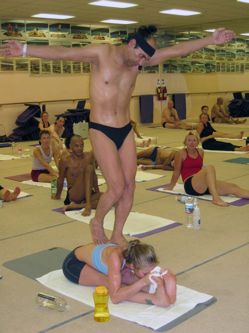
I must have drifted off for awhile as I found myself in a dream. I was teaching. It was as if I just walked into the room, and my students were already doing their practice. I saw that they were straining and efforting to do their postures. They were "helping" each other. In seated wide legged forward folds (uppavistakonasana), the legs were being pushed wider. In seated bound angle pose (baddhakonasana) a friend was sitting on each knee. Students were working hard to bring a leg behind their head. A student doing forward splits (hanumanasana) had friends pressing down on each thigh with a foot.
Bikram Choudhury dancing on student's back
It didn't seem like Yoga Spirit Studios at all and I seemed not to have a voice to call the class to order. Then I realised that I was not the teacher but it was as if I was observing memory. As happens in dreams it was a mash up, and I was aware that I was in the dreaming state, curiously aware of my dream.

Awake again, welcoming the dull ache and a sense of too warm, I tried to think where this idea had come from that bodies need to be forced to do things that they are structurally unsuited to. Writing perhaps around 200CE Patanjali had said that the posture should be steady and easy, or at ease, or spacious, or comfortable (sukha), but he was not referring to uppavistakonasana, baddhakonasana or hanumanasana, but any seated posture taken for pranayama and meditation.

Indeed, in the Yoga Sutras there are 2 sutras that refer to asana, and 89 on concentration, meditation and the states of samadhi.

By the time Hatha Yoga arises from Tantra and Svatmarama writes the Hatha Yoga Pradipika in the fifteenth century (yes folks, that recent) just 15 yogasanas are mentioned. They are described, and several are pointed to as excellent, but we have no idea how the yoga gurus taught them to their disciples.

Even in this text, the first chapter might be called Asana, and it does contain 63 verses, but only 15 postures are described and a lot is discussed that is not asana. There are 124 verses in chapter 4 on meditation and samadhi. Even back then the emphasis was not on doing fancy postures.

Tradition and the wisdom that we are given from a long time ago is a wonderful thing and should be respected. But everything needs to be freshly examined and tested with a curious mind asking "is this true to me, now?" It is a tricky thing, balancing respect of tradition and insights only available to us in modern times.

We can track the evolution of yoga, through different ideas and practices, yet we have no idea how the physical practices of asana were practised. Our knowledge is limited to a few descriptions in old texts and what we know from direct transmission only from the twentieth century on. Most of the postures we now practise in our western yoga classes were not described in those old texts. We really cannot rely upon tradition.

My dream was memory.  I have been in yoga classes where some of these things happen. They probably still do. And it is not confined to yoga. In all kinds of athletic and artistic physical disciplines, this kind of thing is still normal. Such practices are saying that the body should fit into an external concept of what perfect is. This body is not yet perfect. But if we do this perhaps we can make it so.

If that is the tradition, then it is a tradition that needs to be questioned. We now understand the uniqueness of each individual's anatomy. Frankly, not everyone will ever do Hanumanasana, or Padmasana, or Kurmasana  in that externally evaluated "perfect" way. Better by far to let the yoga help you discover and connect with your body and to discover what the pose can teach you, letting go of the thought that you are somehow imperfect for how your body responds.

Sleep came, and when I awoke I felt refreshed. The ache of the night had an excellent message for me. I had been neglecting my morning practices on the mat, cutting them short.  I headed for the studio, landed on the mat and luxuriated in the somatics practices that serve me well before my students arrived for the 8am class.

Wednesday, September 13, 2017

The inner gaze: drishti, pratyahara and dharana

Do you ever catch yourself out during a yoga class having a wandering gaze? 

Those times when you realise you have been scrutinizing the great tights the girl in front is wearing, checking out the state of your pedicure and wondering how does that person on the next mat manage to always have such neat equipment when your own gets strewn all over the place!

It is great that you noticed, as that is the point at which you can return to the practice, bringing yourself back inside for the concentrated practice of yoga.


Drishta is a Sanskrit word meaning that which is seen, the visible, the manifested. Drishti is a verb - seeing, beholding. In yoga practice it comes to mean focused gaze, whether that is inward or outward. If we "take a drishti" we find a point of focus.

Thus when we are taking a balance pose such as tree pose, we might find a mark on the floor or wall in front of us and turn our gazing there, thus we have a drishti that helps us to balance. The moment we let our eyes wander, are distracted by the wobble of another person in the class, we might begin to lose our balance. The focused gaze keeps us steady.

In other asana practice we might keep our gaze on a part of the body. In Virabhadrasana 2 (Warrior 2) the drishti often suggested is the middle finger of the leading hand. In some traditions it might be the thumb. In Paschimottonasana (seated straight legged forward bend) the drishti might be the toes.

The drishti may be ostensibly outward but there is always an element of the inner gaze in the practice. For this reason it is not a hard gaze but is practised with a soft focus. Practising drishti is actually turning our focus inward. By preventing us from being distracted by the people and objects around us drishti practice allows us to attend more closely to the nuances of the sensations of the body and the movement of energetic flows in the body. Practice with drishti and you might find that a whole class goes by and you have been in a zone of meditative felt sensation in movement and in stillness.

In this way drishti becomes a tool in the practice of pratyahara.

The Sanskrit word pratyahara means withdrawal. In yoga it is offered as a practice of withdrawal of the senses from external objects. Sage Patanjali gives pratyahara as the fifth limb of yoga. It is poised between four external practices, the yamas and niyamas (ethics and behaviours), asana (posture) and pranayama (practices of breath and energy), and three inner, meditative states of dharana (concentration) dhyana (meditation) and samadhi (realisiation).

The drishti, or soft-focussed gaze, loosens our attachment to all of the other sensory stimuli and moves us toward the practice of pratyahara in which we come inward, to the inner gaze.

Drishti is also a step on the path to dharana or concentration. The very act of focus is an act of concentration. The practice of drishti in an asana (posture) practice shifts posture and movement to the realm of meditation and is training in dharana that will come in handy when doing a seated, or still meditation.

If practising drishti eyes open in an asana practice the focus can be anywhere and it will need to shift as you go from one posture to another. The practice here is to be mindful of how it shifts. Some traditions give specific drishti points for different postures (Ashtanga Yoga created by Pattabis Jois gives nine). But what will work for one person may not for another. In Trikonasana (Triangle pose) and Parsvakonasana (side angle pose) you might find your drishti up, out or down. Where do you find balance, where are you turning inward? Go there!

A short drishti practice

Seated or standing, start with the hands in anjali mudra (prayer position) before the heart centre. Gaze softly at the finger tips.

Keep the gaze at the fingertips as you slowly point the fingers out, and then roll the hands to palms up, fingertips still touching.

Draw the hands apart opening arms wide and then raising them overhead as you try to keep the fingertips of both hands in view, note how they move to the peripheral vision. What happens when they disappear from view? Let the head turn up, eyes seeking the finger tips as you draw the hands together in anjali mudra (prayer hands) above the head. Your drishti will need to be content with the heels of the hands, but then as the hands draw back down to the heart, there are the fingertips in sight again.

Repeat a few times to see how it goes. You might then incorporate this into your asana practice next time you are on the mat.

Tuesday, February 7, 2017

Not knowing and being OK with that

In yoga inquiry there is often no hard and fast answer. Where should I be feeling it in this asana?  Where is my Muladhara chakra? What should my asana look like? As teachers we should not and indeed, if honest, cannot give the student the answer to such questions. This is a conundrum for the student who really likes to have a definitive answer.
Where should I feel this? I don't know, where do you feel it?
Photo credit: Still from David Garrigues Asana Kitchen
Upa Vista Konasana on You Tube 


Travel has a way of getting you out of your comfort zone, into confusion. And out of all of that comes growth and new understandings. It throws a light on the culture we are visiting, but that then reflects right back on the home culture and then on being human itself. We never know what insights will come. We just travel, experience and later reflect.

Upon my return from India last month a friend asked if I would be writing about the experience, and I responded that I had to let it all settle and filter through first. It's happening.

Being home all the stuff of life and work begins to happen. Now though it is all filtered through the screen of the travel experience.

As Westerners we seem to want definitive answers to everything. And of course we are also very swayed by the findings of Western scientific method. Which is great, my western mind just loves it when there is a definitive answer to something.  Having lived a few decades I also have been around long enough to know that there are fields where science had definitive answers yesterday that turned out to be not so definitive at all. Woops! For instance, what we once understood to be the "best diet" (low fat) is now challenged by new research, and we are all confused!

That might be annoying if we are sincerely trying to eat in the most healthy way, and how dare they change their minds, and what is the right answer anyway?

But confusion is great. Fabulous.
Confusion precedes growth.

As Westerners we are also very keen to manipulate nature whenever we want to achieve a desired outcome. When I am in the garden I will pull and hack away at anything I didn't invite or didn't want to grow that big or in that place.  And if something is in the way of the new scheme, then it goes.  Call me heartless!

My Indian husband is much less inclined to rip things out, like when we were extending the house, he was very upset when a mature hibiscus that was under the footprint of the extension, was ripped out.

And I have to say, while there are many examples of cruelty in India, in a deep cultural sense there is a cultural disposition not to kill. For example, instead of culling stray dogs, they tolerate them roaming in packs, howling at night, and posing a threat to their wellbeing. I've seen trees literally growing through buildings, trunks and roots inserting themselves into walls. In the west the tree just wouldn't be tolerated long enough for it to become an integral part of the building.

Yoga grew first in an Indian context, so when reflecting on Indian culture it can become a reflection on our experience of yoga too, perhaps there are insights here. The very first thing Patanjali would have us observe is ahimsa, not harming. So I need to reflect on what my weeding and hacking in the garden is really all about, in the light of ahimsa. Should I let the sword fern crowd out, choke and hide the other plants I lovingly put there, or accept living in a honeysuckle jungle? Because to control them requires harming some kind of life.

You can see what is happening though can't you. My western mind wants definitive answers. I want to know. I want a definition. I am thinking I don't know enough because these confusions and conundrums are present. Limited knowing, hello!

If we move this onto the mat, if I am confused, and I am asking, where should I be feeling this (asana, chakra, kosha), what should I be looking like, where should my hand be in this asana, I am looking for definition where perhaps there is none.

Rather, we need to let go of a need to know definitive answers to everything, to recognise the kanchuka of limited knowing, turn the other way and follow it home, simply explore and uncover, what is.


Wednesday, September 7, 2016

Yoga trends in the fitness industry and why it doesn't belong there

It bothers me when I am filling out forms, like the census form, when I needed to describe the industry I work in, or the industry that the business is in, as happened when opening a new bank account the other day. It seems to be a choice between fitness industry or health professionals. Sometimes allied health is available, so I choose that one because inner well-being and equanimity certainly leads to better health.

Yoga is a big word for only four letters. It was used for at least two millennia without a trikonasana in sight to mean both a goal, an end-state, and a range of practices to reach the goal. It means union and refers to a recognition of our True Nature as whole and undivided. Since the middle ages, body positive Tantric practices created Hatha Yoga, which added body postures to the range of practices that would assist us in finding that wholeness, that union inherent in the word yoga.

Roll the clock forward and yoga has taken on a meaning that places it in the fitness industry, and it seems in danger of losing its real meaning and original purpose. The American College of Sports Medicine, when it published its "Fitness Trends for 2016, ranked "wearable technology" number 1 and "yoga" number 10! (News article) Yoga is a fitness trend!

I have wondered if this is cultural appropriation? Is this an upsetting trend to Indians to whom the word yoga rightfully belongs?

I enjoyed this article which compares yoga in India and Seattle. The author, Arundhati Baltmangalkar, reports on how she adjusted to the yoga world in Seattle when she migrated from India. Her generous attitude helped me attain a more generous outlook as well. She says:

"I knew of different styles and lineages, but the idea of chocolate yoga, yoga to live music, rock and roll yoga, naked yoga, love yoga, etc. would shock the daylights out of me. Coming from a traditional yoga background, I often found myself annoyed and upset, but soon learned to ignore the eccentric ideas that have borrowed the name of yoga."

Those last words seem to be the nub of it. Much of what is understood as yoga these days is just a borrowed name.  If it is fitness stripped of those aspects which teach us a more wholesome way to live, that lead us to know our inner wholeness, then it cannot really be yoga and it has only borrowed the name.

But what if the name has become so disconnected from its real meaning and the practices that it represents that those who offer a traditional yoga are feeling unable to use the word?

It has been suggested to me that people who come to a class called "yoga" are expecting a fitness class, and are disappointed if they do not get it. So if we are offering real yoga, we should call it something else that will attract the true seekers, not those looking for fitness.

I tend to balk at that. If anyone should drop the word yoga it should be those who have "borrowed it" and stripped it of relationship to its real meaning. But that is unlikely to happen. A multi-billion dollar industry is now built around the word, yoga fashion and yoga accessories fuel desire for more possessions.

Patanjali gave us ethical precepts or behaviours as the place to start our practise of yoga. One of these is non-possessiveness. The person taking yoga seriously in the west has some big challenges as they resist the influence of those who have borrowed the term.

I would love to hear what you think. Please leave a comment.


Tuesday, March 1, 2016

Practice makes perfect

It is true, that which we practice we get better at. That being true, we need to be careful of what it is we are practising.


Yesterday I got my grumpy pants on.   I am so grateful that this was observed to me, because if I had gone on practising that, I would have achieved the perfect bad mood and soured things for myself and those around me. Today that got me thinking about practice in general, yoga practice in particular (there is no difference actually) and the Yoga Sutras and how we must be careful of what we practise in every area of our life.

In our physical practice of Asana it is important to remain vigilant to discover or uncover any misalignment for if we do not we are just continuing to practise and get better at something that is inherently unsound, perhaps even leading to injury. Sometimes we might have very ingrained movement patterns we are not even aware of. These might be creating imbalance in the body and pain might be the result. With the assistance of our teacher we can start to uncover these and to repattern our movement and eventually perfect something that has much healthier consequences.

It is similar for the non-physical areas of practice.

In the Yoga Sutras, Patanjali has given us a manual for the practice of yoga. OK, so it is rather short on what we tend these days to think of as yoga, all those postures! But the postures are not really yoga, not in themselves. Right in the second sutra Sage Patanjali tells us what yoga is.
I.2. Yoga is the stilling of the movement of thought in the indivisible intelligence.
What he sets out in the sutras is a path to attain that state, and these days we can add our posture work to the path. Patanjali's path leads us to the practices of meditation - withdrawing from distractions, concentrating, mindfulness and absorption. This is the path of Raja Yoga, but he very compassionately gives us practices for everyday living to begin with that prepare our minds for what is to come.

So it is that at I.33. Patanjali provides a method of attitude towards our relationships with others.
II.33. Four attitudes to vicissitudes are conducive to peace of mind:
(1) Friendliness towards the joyful
(2) Compassion for the sorrowful
(3) Rejoicing in goodness
(4) Indifference to badness - not being drawn into it nor holding others in contempt for it
When we practice these we are changing our brains, shifting it away from suffering and into joy. And the more we practise, the better we get at them.

The reverse is also true. If we resent the joy we find, we become well-practised at being resentful; if we do not cultivate compassion a sour heart will taint our well-being; if we fail to rejoice in goodness and do not endeavour to surround ourselves with good people, and if we are caught up in badness, badness is what we will perfect.

Later, in Book Two, Patanjali give us more codes for living in the yamas and niyamas. But right here in Book One we have things we can do, attitudes to practice that are most definitely yoga.

Yesterday in my grumpy pants I stepped off the path for a moment.  I am so glad I quickly found my way back on again.

Keep practising, but make sure it is the right thing!

With love
Tina


Tuesday, July 7, 2015

Surrender

Could surrender be the next big step in your yoga practice?


Remember the Niyamas?  They are the second limb of the eight laid out by Patanjali in the Yoga Sutras. The Niyamas are the personal observances such as purity, contentment, diligence, and introspection. The fifth Niyama is "Ishwara Pranidhana".

Ishwara is often translated as "God" but is more of a concept with a wide range of meanings depending on the philosophical underpinning of its use. It could be translated as Higher Self. Depending on belief, faith or lack of it, the word Ishwara may be challenging for some.

Then there is "prandhana". Layered with meanings of devotion, dedication, respectful attention, the word often is translated as "surrender".

The English word surrender may seem to render us weak. Vanquished armies surrender, the loser surrenders. Is Patanjali asking me to be a loser? It is possible that the whole concept of surrender does not sit easily with us, especially for individualistic Westerners in a culture that makes dominance a virtue. I might think that if I surrender I will become a door mat, and the I that is doing that thinking rebels against that.  This is the ego-I at work.

Furthermore, "surrender to God" might really be a step too far!

Surrender is the ultimate act of letting go of our ego. Love is surrender. Think of a time when you were consciously loving, filled with love for another. Love places the other ahead of oneself, and as such it is devotion, dedication, respectful attention and surrender. The ego-I that does not wish to be a door mat has no place in a heart filled with love.

Patanjali points us to surrender to "Ishwara" as this is the path to move beyond that ego-I that stands in the way of our unification and wholeness with the ground of our Being. It doesn't really matter how we conceive of Ishwara - for some it will be Jesus, for others Mother Mary, or God, for others an Earth Mother, or Siva ... that which resonates with the individual is what is important.

Whether we are on the mat or in daily life, the fifth niyama invites us to dedicate all action and all inaction to that higher force, so that we can shift that ego-I out of the way and transform our lives into an congruous flow of love and wholeness.

When you are next on the mat practising yoga, could you surrender, to the breath, to release, to the felt sense of the shape you are adopting? Could you surrender thoughts to sensation, sensation to just being?

Tuesday, June 2, 2015

How to catch a monkey


  • Take a coconut and drill a hole in it just big enough for a monkey's open hand to fit through.
  • Tie the coconut down to the ground
  • Put something inside the coconut that the monkey will find irresistible, such as peanuts or banana
  • Wait
The monkey will soon come along and reach inside the coconut to grab the delight inside. But with his fist firmly around the treat he is unable to draw his hand back out. The monkey is most reluctant to let go of the treat and remains trapped!

This simple method of catching the monkey is a parable for our own suffering. Our attachment keeps us trapped in the condition of suffering.  Just as the monkey would only need to let go of the bait to be free, all we need to do is to release our attachment.

The Buddha gave the three causes of suffering to be attachment, anger and ignorance.

Patanjali, who wrote the "Yoga Sutras" lists five causes: ignorance (of our true nature); our ego, which defines us as many things, but blinds us to our true self; attachment, like the monkey; aversion or resistance, which is the flip side of attachment; and, fear of death. 

We are advised by the sages to still the mind. I suspect that this is even harder for modern people in the information age to do than it was before the endless barrage of electronically conveyed visual sand mental stimulation. 

I have noticed that when people come to meditation courses quietening the mind is often one of their motivations, yet when people sign up for asana classes relaxation, flexibility, strength and fitness are more often the reasons given. It doesn't matter really. 

If we learn the techniques of meditation we learn techniques to still the mind. It will however be challenging.

In a movement based asana practice, we may first engage in the outward sensations of the body, and the mind may be challenged initially to connect with the body, to discover a sense of its place in space. We may be confronted by limitations of the body. Yet the more we practice, the more we familiarise with the poses of yoga, the more we begin to turn inward, and the practice becomes a moving meditation. In the end we do begin to open to ourselves, to the possibility of discovering our true nature.


Wednesday, May 20, 2015

Cultivating right attitudes

First published in "on the Mat", the newsletter of Yoga Spirit Studios

Switching on the news can be quite depressing can't it? We should ensure we are informed about what is happening in our world, hiding our heads in the sand will not help. But there is so much violence, and so many people swept up in terror, death and destruction. I find myself very moved by it and frustrated too that as individuals we can do nothing to change it.
What we can do is cultivate the right attitudes in our own heart, ensure that we are wiring our own brains towards non-violence.

Non-violence, or ahimsa is the first practice that Patanjali offers in the Yoga Sutras, the very first of the yamas, which is the first of the eight limbs of yoga he lays out in Book 2, the Book on Practice.

However today I am drawn by a sutra in Book 1, sutra 33.

The mind becomes quiet when it cultivates
friendliness in the presence of happiness, 
active compassion in the presence of unhappiness, 
joy in the presence of virtue 
and indifference toward error. 

Sounds easy enough. But is it? In this sutra we are being given the clue to much needed equanimity in the face of all we meet, equanimity that will guide us into right action to fulfill our responsibilities.

Friendliness in the face of happiness: Sometimes another's success serves to remind us of our own failings and this may set our minds in an unfriendly direction. cultivate friendliness. Note the feelings of unfriendliness if they arise, invite it in, and then also invite friendliness. Move back and forwards between them. You will find that the unfriendliness loosens its grip upon you and you have cultivated friendliness.

Active compassion in the presence of unhappiness: It is relatively easy to be compassionate in the face of a friend's bereavement but what about the unhappiness of a homeless person, or a drunk or drug addict. Faced with the homeless person, drunk or drug addict, right there in front of us, do we feel compassion or aversion? First we can note that tendency, but then can we open ourselves to be with the other's suffering, acknowledging our oneness?

Joy in the presence of virtue: Is there a contraction present when we see the good works of others, perhaps because we feel ourselves to be unworthy or incapable of such giving? Note that. Then can we cultivate, feel its opposite as joy?

Indifference towards error: Why indifference? Does that mean we should not act when error is present, as in the bombing of children or passenger planes? The lesson here is to note the passion, the sadness, the anger, and the sense of impotence that arises in the face of error, note it and welcome it, and then chose equanimity, (indifference) as its opposite and cultivate that. Then we can act from the correct place, we can respond rather than react.

So much of the ever spiralling vortices of violence we see are fuelled by unskillful reaction based on hatred and fear. Patanjali offers another way and what better place to start than with ourselves, where we can act to make a change.

Wednesday, January 7, 2015

Namaste

First published in "On the Mat" September 2011

Namaste - though it literally translates as "I bow to you", some say it signifies "the Divine in me salutes the Divine in you".

First day of September was Ganesh Chaturthi this year. How apt! Lord Ganesha, Remover of Obstacles, is propitiated for all new beginnings, and spring is a great new beginning. It followed closely upon the birthday of Lord Krishna, Krishna Jamnasthami, on 22 August. 9 September is Onam, a harvest festival in the southern state of Kerala. Soon arising on the Hindu calendar are Navaraatri, the nine nights of celebration of the Goddess in her many forms, commencing 28 September, and Diwali, the festival of lights, on 26 October.

Always comfortable with paradox, Hinduism has many deities, yet still acknowledges just one Divine Presence. Whether we focus on the Divine Mother, powerful Shakti, the Remover of Obstacles or the Divine cowherd, all are aspects of the one, and the One is everywhere, including in ourselves.

When we salute the Divine in other people and in other life forms, and treasure it in ourselves, we have the foundation of Ahimsa, non-violence and compassion, first of the Yamas which comprise the first of the eight limbs of Patanjali's Yoga. To acknowledge the Divine flowing through us all, how could we not be compassionate.

Sunday, August 3, 2014

The body is a temple

Over the eons people have intuited A Divine Presence, have told stories to bring that awareness to life, and have erected beautiful temples to celebrate it and to visit to bring them closer to its power and grace. Many rituals of purity also developed. It is understandable that if you had a temple that housed a powerful deity, you would want to keep it clean.

In yoga we come to understand that the Divine, or Universal Consciousness, or whatever you wish to call it, is accessible within ourselves.

This makes our body the temple. So it is worthwhile to consider what we can do to make it a pure and sacred space. The thoughts we think, the attitudes we embrace, the food we eat, the words we speak, are all to be considered in our quest for sauca (pronounced "sowcha"), purity.

In fact, sauca is the first Niyama, or personal practice, mentioned by Patanjali in the Yoga Sutras.

The yogi sages also developed practices to purify the body, called shatkarma. One of these is neti or nasal cleansing. Jala neti, water cleansing, is an excellent daily practice to keep the nasal passages clean and healthy. It is recommended for anyone who has sinus conditions. It removes dirt, bacteria and mucus from the nasal cavities. The saline solution will toughen up the nasal membranes so they are less susceptible to infection and allergy. Some people even report that it helps in giving up smoking!

There are many different shaped neti pots besides the one pictured. The way to use them is to use a mildly saline solution of water. Use sea salt if available, and not iodised salt in the proportion of on teaspoon for half a litre of water, which is the same as human blood. The water should be around body temperature, slightly warmer is better than cooler. Test as for a baby's bottle. You turn your head one the side and insert the spout of your pot into the upper nostril and allow the water to drain through the nasal passages and out the other nostril until half the solution is gone. Gently blow out through both nostrils to clear and then repeat on the other side.

Now take a deep forward bend, uttanasana, and look towards the floor, breath in through the mouth and out through the nose. Then look towards your knees and again breathe in through your mouth and out through your nose. Some water may drain. Come up gently and do some rapid sniffing breaths, first through both nostrils, in and out, and then through each nostril individually. This will dry the nasal passages.


(First published in "On the Mat", the newsletter of Yoga Spirit Studios.)