Showing posts with label Divine Feminine. Show all posts

Thursday, June 21, 2018

Visitations that come in the night

I was lying in bed awake in the middle of the night last Friday night.  As I have to leave the house at 7am in the morning on Saturdays, being awake in the middle of the night on Friday nights is a trifle problematic, but nevertheless, I welcomed it as an opportunity for practice. So I was practising welcoming awakeness and also welcoming the dull ache in my right sacroiliac joint that I felt sure had something to do with my awakeness. There was much to be grateful for here as a real episode of my SIJ instability would have my entire hip and right pelvis, inside and outside, in spasms of pain.  That really can wake you up at night! No, not that, just a dull ache, welcome that.

Showing adjustments I don't think are a great idea
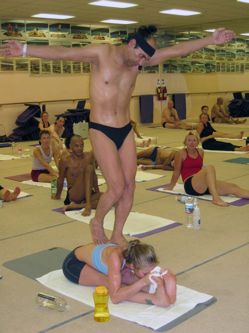
I must have drifted off for awhile as I found myself in a dream. I was teaching. It was as if I just walked into the room, and my students were already doing their practice. I saw that they were straining and efforting to do their postures. They were "helping" each other. In seated wide legged forward folds (uppavistakonasana), the legs were being pushed wider. In seated bound angle pose (baddhakonasana) a friend was sitting on each knee. Students were working hard to bring a leg behind their head. A student doing forward splits (hanumanasana) had friends pressing down on each thigh with a foot.
Bikram Choudhury dancing on student's back
It didn't seem like Yoga Spirit Studios at all and I seemed not to have a voice to call the class to order. Then I realised that I was not the teacher but it was as if I was observing memory. As happens in dreams it was a mash up, and I was aware that I was in the dreaming state, curiously aware of my dream.

Awake again, welcoming the dull ache and a sense of too warm, I tried to think where this idea had come from that bodies need to be forced to do things that they are structurally unsuited to. Writing perhaps around 200CE Patanjali had said that the posture should be steady and easy, or at ease, or spacious, or comfortable (sukha), but he was not referring to uppavistakonasana, baddhakonasana or hanumanasana, but any seated posture taken for pranayama and meditation.

Indeed, in the Yoga Sutras there are 2 sutras that refer to asana, and 89 on concentration, meditation and the states of samadhi.

By the time Hatha Yoga arises from Tantra and Svatmarama writes the Hatha Yoga Pradipika in the fifteenth century (yes folks, that recent) just 15 yogasanas are mentioned. They are described, and several are pointed to as excellent, but we have no idea how the yoga gurus taught them to their disciples.

Even in this text, the first chapter might be called Asana, and it does contain 63 verses, but only 15 postures are described and a lot is discussed that is not asana. There are 124 verses in chapter 4 on meditation and samadhi. Even back then the emphasis was not on doing fancy postures.

Tradition and the wisdom that we are given from a long time ago is a wonderful thing and should be respected. But everything needs to be freshly examined and tested with a curious mind asking "is this true to me, now?" It is a tricky thing, balancing respect of tradition and insights only available to us in modern times.

We can track the evolution of yoga, through different ideas and practices, yet we have no idea how the physical practices of asana were practised. Our knowledge is limited to a few descriptions in old texts and what we know from direct transmission only from the twentieth century on. Most of the postures we now practise in our western yoga classes were not described in those old texts. We really cannot rely upon tradition.

My dream was memory.  I have been in yoga classes where some of these things happen. They probably still do. And it is not confined to yoga. In all kinds of athletic and artistic physical disciplines, this kind of thing is still normal. Such practices are saying that the body should fit into an external concept of what perfect is. This body is not yet perfect. But if we do this perhaps we can make it so.

If that is the tradition, then it is a tradition that needs to be questioned. We now understand the uniqueness of each individual's anatomy. Frankly, not everyone will ever do Hanumanasana, or Padmasana, or Kurmasana  in that externally evaluated "perfect" way. Better by far to let the yoga help you discover and connect with your body and to discover what the pose can teach you, letting go of the thought that you are somehow imperfect for how your body responds.

Sleep came, and when I awoke I felt refreshed. The ache of the night had an excellent message for me. I had been neglecting my morning practices on the mat, cutting them short.  I headed for the studio, landed on the mat and luxuriated in the somatics practices that serve me well before my students arrived for the 8am class.

Monday, March 26, 2018

The Ishtar story

Ishtar is a Mesopotamian goddess with an interesting story. She was Inanna to the Sumerians, Ishtar to the later Akkadians, Babylonian and Assyrians. In this week before Easter, it is timely to talk about her as some claim that her name was later appropriated as Easter., though this is debated. Ishtar was the Queen of Heaven and presided over sexuality and fertility, and is identified with the morning and evening star.
Photo credit: Wikipedia - Cylinder seal from ancient Akkadia
depicting Inanna/Ishta in a style we later see as Durga in India.

One of Ishtar's most famous stories is of her Descent into the Underworld. I will try to do it justice in summary.

The Underworld is ruled by her sister Ereshkigal, and it is not a place that folk usually return from. So before departing she arranges for the deities to rescue her if she does not return in three days. She dresses up in elaborate clothing and jewellery to denote her power and status.

To descend she must pass through seven gates. At each gate, in order to pass, she must surrender part of her clothing or jewellery and power objects, and so her power is progressively removed from her. When she arrives before Ereshkigal she is naked and powerless. Thus it is that her sister is able to overcome Ishtar and inflict such torments upon her that she dies and is cast upon a tree. On earth the consequence is the complete cessation of sexual activity, and thus of fertility.

However, Ishtar has her insurance policy and when she does not return, her faithful servant turns to the gods to rescue her and one of them responds, creating two sexless figures and instructing them on demanding Ishtar's corpse and how they must sprinkle it with the food and water of life.

This they do, gaining Ishtar's corpse from Ereshkigal with some drama, revive her and enable her to ascend, back through the seven gates, and as she passes them she regains the items she lost on the descent, regaining her powers.

When the Assyrians converted to Christianity, the cult of Ishtar was appropriated into Christian practice, many aspects of her worship entering into the cult of MaryAnd so too there is the claim that her name being taken on for the festival of Easter, along with practices of the fertility cult (eggs and rabbits). Even aspects of the Passion of Christ bear remarkable resemblance to Ishtar's descent into the underworld, the three days of death cast upon a tree (the cross), the resurrection and ascent to Heaven again.

There are other parallels with Ishtar in the cosmology of India. The Goddess Durga bears resemblance to Ishtar. And if we look west, the Germanic Goddess Eostre, whose name might also give rise to Easter, is a fertility goddess and associated with dawn (morning star).

The seven gates can be interpreted as the chakras. From base chakra to crown the seven chakras move from the gross to the subtle, from earth element, through water, fire and air, and in the higher chakras, increasingly rarified space. Ishtar's descent is a descent into embodiment, and in embodiment is life's opposite, death. But just as she could descend into embodiment, and die, so too could she ascend, becoming whole (restoration of powers) as she does. But the wholeness is always there. ascent through the chakras connects us with that essential spaciousness of Awareness which is always here. So the ascent is the salvation, and it is available to us all.

Thursday, October 6, 2016

Navaratri

First published in "On the Mat" 2013 

While traditions vary across India, the festival of Navaratri honours the Goddess in her different forms, mainly as Saraswati, Goddess of learning and culture, Lakshmi, Goddess of wealth and prosperity, and Durga, Goddess of strength, courage and encompassing the ferocity of a mother in protecting her young.
Maa Durga

The word navaratri literally means nine nights, and the festival of Navaratri lasts nine days and nine nights. It occurs during the first nine days of the bright half of the month of Aashwayyuja in the Indian calendar. In our western calendar it is a "moveable feast" like Easter is, because the western calendar is not linked to the phases of the moon.

West Bengal celebrates Navaratri as Durga Puja. Kolkata (Calcutta) probably derived its name form Kali, another name of Durga. The last three nights and days are given over to magnificent welcomings of Maa Durga to her earthly home. Huge displays of earthen sculptures of Durga with her sons Ganesha and  Kartika, and Saraswati and Lakshmi are erected as the focus of large communal prayer meetings followed by mass feedings and cultural celebrations. On the tenth day they are taken in a procession to a nearby river where they are ceremoniously immersed.

Dancing Dandiya in tradiational dress
In western India, especially in the state of Gugarat, people spend the nine nights in party mode, dancing the garba and dandiya dances all through the night, with a puja for the Goddess and food served for everyone present. Women dressed in beautiful brightly coloured clothes with a wide skirt, blouse and scarf draped gracefully, dance the garba, a graceful dance in circular patterns, moving in a big circle around a central pot containing a lamp. Men and women participate in the dandiya, which features bamboo sticks held in the hands that are brought together, either one's own or another's, as the intricate patterns of the dance proceed.  The dance commences slowly but as it progresses the tempo increases to a frenzy.

In Mysore in the southern state of Karnataka, the biggest day is Dusshera, the tenth day after Navaratri, when the city turns on a parade to celebrate Chamundi, a form of Durga, and her victory over the demon. Chamundi is the family deity of the Maharaja of Mysore and the parade features the palace elephants decked out in all their glory,hoses and courtiers, who wend their way throughout he city and all the way to Chamundi Hill which overlooks the city.

A typical golu display
Many places throughout India have a custom during Navaratri of erecting tiered displays of dolls called by various names such as golu, kolu, bombe habba, bommala koluvlu. The displays are erected in the house on an odd number of tiers (usually 7, 9 or 11). Just like we store our Christmas decorations and get them  out from some high shelf, or from under a bed where they have languished for a year, so too the golu dolls emerge at the beginning of the festival, the steps are arranged and the dolls displayed. Deities are displayed on the top tiers, and depictions of householders lower down as well as animals on the lower shelves. Women and children visit each other during this festival to view each other's displays, sing some bhajans for the goddess and take home packages of prasadam from that house (often the day's sundal, see the recipe section). Unlike Christmas trees which can tend to linger for ages, the golu display is promptly packed up at the end of the festival and put away for another year.


Friday, July 1, 2016

The dance of ever renewing delight

I recently spent a week on retreat, in silence, while also being in community. Try imagining sitting in a dining room full of other people and talking to no-one. Many find it impossible to imagine.

What a treat it was! And a week did not seem long enough in the end.

Silence doesn't only mean "not talking". It means "not doing anything that will take you away from the ongoing meditation and stilling of the fluctuations of the mind". Pretty much no texting, emailing, reading the frivolous, like Facebook,. I didn't take a computer, and the only book I had was my handbag sized copy of the Yoga Sutras interpretively translated by Swami Venkatesananda, as it goes wherever my handbag goes. I did indeed open and read it on a few occasions at night and during the long afternoon breaks, finding that it could take me deeper, rather than taking me away.

Another text that might have also taken me deeper would have been the Radiance Sutras had I thought to take it. Many of the meditation practices we did on retreat were from the Radiance Sutras.

The retreat was titled "Embodied Awakening" and was led by a very talented teacher, Anne Douglas. The title indicates that the body itself is a gateway to awakening. As we come into a heightened sensitivity to information of the body we start to open all of our perception, including to the experiences that are beyond the body.

Through repeated body-sensing practices, meditation and Yoga Nidra, and by not interspersing this with the things that would take us away, we began to enter a more awake state.  An awakeness that is awake no matter what the state of the body, awake even if the body sleeps, dreaming or dreamless, and awake in a vaster sense than ordinary wakeful states.

The Radiance Sutras are Lorin Roche's beautiful, modern, interpretive translation of the Vijnana Bhairava Tantra (c.800CE), a lovely text from the tradition of Kashmir Shaivism. The title of this post is taken from Sutra 156.

Let me share Sutras 155 -156 with you.

155
Breath flows
Into this body
As a nectar of the gods. 
Every breath is a whisper
Of the Goddess:
"Here is the ritual I ask of you -
Be the cup
Into which I pour this bliss,
The elixir of immortal peace." 
156
The breath flows out with the sound
sa,
The breath flows in with the sound
ha.
Thus thousands of times a day,
Everyone who breathes is adoring the Goddess. 
Know this, and be in great joy.
Listen to the ongoing prayer that is breath.
Life shall dance in you
A dance of ever-renewing delight.
Perhaps you are put off by this talk of "the Goddess" so lets talk about that. Who is this Goddess?

The text comes from the tradition of Kashmir Shaivism. The "Goddess" is, at a story-telling level, the consort of Shiva, who is sometimes called Parvati, but also is known as Shakti. But such terms are actually metaphorical. This God and Goddess are not personalities, they are the Universe, and they are in fact one. The Goddess is the energetic aspect of Consciousness that causes manifestation. In other words, Shakti causes Divine Consciousness to pulse, and matter to come into being. These concepts have a very nice correlation with astrophysics!

So everything is really Shiva-Shakti, and you can experience this, in your body. Your body becomes a pathway to knowing the Divine and a pathway to returning to the knowledge of your True Nature. So the 112 meditations of the Vijnana Bhairava are 112 gateways of the body to returning to your True Nature.

Here in these two sutras our gateway is the breath. "Be the cup into which I pour this bliss", be receptive to the breath, "be in great joy", "listen to the ongoing prayer", "life shall dance in you".

So next time you are lying quietly - in savasana at the end of your next yoga practice perhaps, or even in bed tonight, waiting for sleep, be receptive, open, listen, feel and quietly let this wondrous experience of the breath be meditation and prayer.

There is a poem about how I was feeling when I returned from retreat here.

You might also be interested in a previous post, Siva - Sakti.


Wednesday, January 7, 2015

Namaste

First published in "On the Mat" September 2011

Namaste - though it literally translates as "I bow to you", some say it signifies "the Divine in me salutes the Divine in you".

First day of September was Ganesh Chaturthi this year. How apt! Lord Ganesha, Remover of Obstacles, is propitiated for all new beginnings, and spring is a great new beginning. It followed closely upon the birthday of Lord Krishna, Krishna Jamnasthami, on 22 August. 9 September is Onam, a harvest festival in the southern state of Kerala. Soon arising on the Hindu calendar are Navaraatri, the nine nights of celebration of the Goddess in her many forms, commencing 28 September, and Diwali, the festival of lights, on 26 October.

Always comfortable with paradox, Hinduism has many deities, yet still acknowledges just one Divine Presence. Whether we focus on the Divine Mother, powerful Shakti, the Remover of Obstacles or the Divine cowherd, all are aspects of the one, and the One is everywhere, including in ourselves.

When we salute the Divine in other people and in other life forms, and treasure it in ourselves, we have the foundation of Ahimsa, non-violence and compassion, first of the Yamas which comprise the first of the eight limbs of Patanjali's Yoga. To acknowledge the Divine flowing through us all, how could we not be compassionate.

Sunday, August 10, 2014

Shiva - Shakti

Everything manifests as a duality. Can you think of the idea of hot, if there were no cold?

In Indian philosophy, Shiva and Shakti are like this, the one does not exist without the other.

Shakti, from the Sanskrit "Shak" - "to be able", is the enabler, the dynamic force which manifests the Universe.

Shiva is the transcendent ground of being.

Without Shakti, the ground of being remains unmanifested and all that we call our physical reality would not exist.

Different cultures have intuited Shakti by different names, but most have a divine feminine, a Great Mother figure.

Have you ever moved amongst great, old trees and felt an undeniable force emanating, a force that evoked feelings of reverence, even though you may not have had a philosophical or spiritual framework to reference it? At such times we are sensing into Shakti.

In yoga we sensitise ourselves to flows of energy in our bodies. Any flow of energy is Shakti.

So although Shakti is characterised as feminine and Shiva as masculine, both are present within all of us, men and women.