Showing posts with label Ahimsa. Show all posts

Saturday, December 5, 2020

Recognising the true teacher

Today I am moved to write on a rather tricky matter. Our world of yoga, like the rest of the world I suppose, has the capacity for people to cross the line between what is appropriate and what is not. 

In a yoga class we should be able to feel safe. Yoga as a practice of body/mind/spirit integration cannot be effective if we do not feel safe. Learning does not take place if we do not feel safe. Yet there are many ways we may not feel safe, and may not be safe in a yoga class.

Ahimsa - non-harming

In the classical yoga of Patanjali's Yoga Sutras, the principle of Ahimsa, non-harming, is the first yama of the five ethical practices that comprise the first limb of yoga. If yoga is truly adhereing to this principle, we would be safe in yoga classes. 

Ahimsa encompasses not only not harming others but also not harming ourselves. In the contect of not hurting ourselves in yoga classes, I believe we may lose some of our agency due to the culture of the class.

Safe from physical injury

In modern postural yoga, physical adjustments have become a norm. Highly respected pioneers of modern postural yoga paved the way for extreme force being applied to bodies to achieve an idealised position perceived as the correct way to do a pose. When yoga becomes gymnastics, when it shifts into the realm of competitive sport, when it becomes ambitious, misjudgement can come in, clear discrimination can dissolve.

The ambition to be "best"

The visual representations of yoga on magazine covers and on yoga memes almost always depicts postures with considerable wow factor. "Good yoga" is identified as being able to bring the body's joints into extreme flexions and extensions, and to be able to hold the body's weight on the hands or even on on one hand.

Many yoga classes perpetuate this idea. When a yoga teacher has bought into that ideal, and perhaps has a body type that is capable of getting into some of the postures, has perhaps trained in a system that lauds such postural work, then the culture of the class is to work the body to achieve the ideal. I've been there, in my youth, the idea of sitting in lotus posture seemed so important, that I worked my legs quite forcefully trying to achieve it. What did I get from it? Injuries in my ankles, and in my sacroiliac joint. 

So with an ambitious culture, students are encouraged to self harm.

Injury caused by adjustments
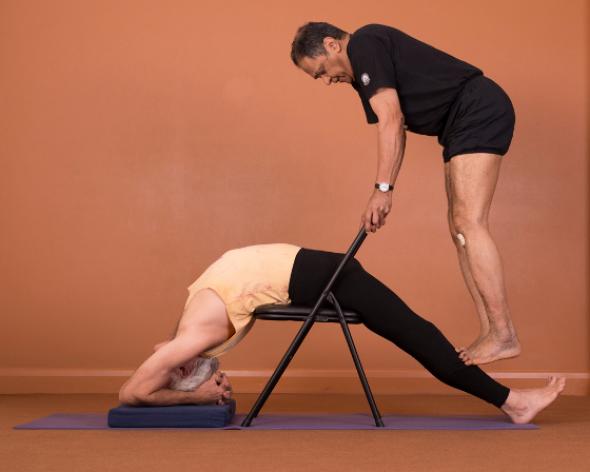


Have you ever received an adjustment in a yoga class that injured you? I have. I was doing my teacher training at the time, which made what happened even more shocking. The teacher who made the adjustment was a recent graduate of the same training, so I have a fair idea of the principles under which she was trained. In that training I was hearing messages about asking for permission before touching, about the unique structures of the human body and how one size never fits all. In this class, the teacher approached and without asking permission, pushed my pelvis to force "alignment" according to her ideas about what that should look like. I hurt for a week. To my horror, she showed up as an unannounced teacher in another studio I attended, ran the same lesson plan and tried to do it again! 

Now I refused that adjustment the second time because I saw it coming. I had quite a while to prepare myself to say no. I was also empowered by what I was learning in my teacher training. I knew that it was not OK, and that I had the right to say no. The problem was, the first time, I had no opportunity to give or withhold consent.

Informed consent

Informed consent implies two things. Firstly, that the person understands what is being consented to and secondly, that given that understanding, clearly says yes, feely and unpressured.

In the case I have related above, the first time, when the adjustment was made, it came out of the blue. We were asked to line up with our backs to the wall, place our feet in a particular position, and do triangle pose, with our lower hand right down to the ankle. The teacher then went around and pushed everyone's pelvis against the wall. I was first. I was not asked if I wanted an adjustment and I was certainly not told what that adjustment would be. There were at least twenty people in that class, and the teacher progressed around the room doing the same adjustment on everyone. You could argue that after the first few, if people were paying attention, they would have known what was coming. But nobody was then asked if they wanted to receive the adjustment. There was no culture established in that class that people were permitted to choose not to receive the adjustment. 

On the second occasion, it just so happened that I was last. I watched as the same scenario played out around the room, and when she got to me I refused. Even though I knew my right to refuse and was determined that I should, I spent her whole round summoning my courage to do so and I stated my refusal with more force than the situation demanded because of my nervousness and stress. Afterwards I felt embarressed. I still remember it. Refusing the teacher's adjustment when I was not asked for permission, the stress involved, was not something I could easily forget.

I have also seen a scenario play out in a workshop. The teacher asked for a volunteer, but did not say exactly what was going to be done. I felt uncomfortable when I saw the teacher walking on the volunteer. I wondered about the volunteer's informed consent, but I did not speak up. I wish I had.

When things become inappropriate or even abusive

In the scenario above not only was there a potential physical harm in the "adjustment" and a lack of informed consent, the area of the body was a very personal place. The walking was on the groin. Additonally the teacher was male, and the volunteer, female.

Think for a moment. If you had known this would be the "adjustment" would you have consented?

The peer pressure and class culture can make it hard to say no, and can even persuade you to participate. If I felt uncomfortable with the first volunteer and her experience, I was amazed at the number of additional volunteers who queued up for the adjustment. 

What a strategy - get the first person to receive an inappropriate manipulation by a total lack of informed consent, thus normalising it, and then they will queue.

And we need to navigate that. It is not easy. It is not easy as a student, if a teacher you respect begins to behave in a way towards you that makes you uncomfortable. It is not easy in a teaching fraternity to call the behaviour we may suspect we are witnessing.

First step - Being safe with ourselves

It is an important lesson to learn on the yoga path, that we should be able to feel safe with ourselves. I will perhaps write a whole blog post about this another day. However, without the ability to feel safe with ourselves our ability to open to the truth of who we really are might be hampered by fear. In the context of not doing ourselves harm we must always keep any promises we make to ourselves.

Empowering yourself and others


In conclusion, we owe it to ourselves and to all others to be brave. Brave to say no, and brave to call it out when we see it. Doing so will empower us all. And if any feeling of "oh oh!" arises, trust it, don't suppress it. Step back from the situation, say, to yourself and everyone else, this does not feel right. This is truly courageous, and it helps to have planned it ahead. 

How to recognise the true teacher? 


You will not feel afraid. You will feel empowered, never knocked down, encouraged to independence, not dependence. The true teacher will stir your quest to learn, but never claim to be the sole source of the answers. 


Photo credits: Images of yoga adjustments are from the blog yogamarie.weebly.com and mariehallagerandersen.weebly.com/ and were accessed on 2 December 20.

Tuesday, February 7, 2017

Not knowing and being OK with that

In yoga inquiry there is often no hard and fast answer. Where should I be feeling it in this asana?  Where is my Muladhara chakra? What should my asana look like? As teachers we should not and indeed, if honest, cannot give the student the answer to such questions. This is a conundrum for the student who really likes to have a definitive answer.
Where should I feel this? I don't know, where do you feel it?
Photo credit: Still from David Garrigues Asana Kitchen
Upa Vista Konasana on You Tube 


Travel has a way of getting you out of your comfort zone, into confusion. And out of all of that comes growth and new understandings. It throws a light on the culture we are visiting, but that then reflects right back on the home culture and then on being human itself. We never know what insights will come. We just travel, experience and later reflect.

Upon my return from India last month a friend asked if I would be writing about the experience, and I responded that I had to let it all settle and filter through first. It's happening.

Being home all the stuff of life and work begins to happen. Now though it is all filtered through the screen of the travel experience.

As Westerners we seem to want definitive answers to everything. And of course we are also very swayed by the findings of Western scientific method. Which is great, my western mind just loves it when there is a definitive answer to something.  Having lived a few decades I also have been around long enough to know that there are fields where science had definitive answers yesterday that turned out to be not so definitive at all. Woops! For instance, what we once understood to be the "best diet" (low fat) is now challenged by new research, and we are all confused!

That might be annoying if we are sincerely trying to eat in the most healthy way, and how dare they change their minds, and what is the right answer anyway?

But confusion is great. Fabulous.
Confusion precedes growth.

As Westerners we are also very keen to manipulate nature whenever we want to achieve a desired outcome. When I am in the garden I will pull and hack away at anything I didn't invite or didn't want to grow that big or in that place.  And if something is in the way of the new scheme, then it goes.  Call me heartless!

My Indian husband is much less inclined to rip things out, like when we were extending the house, he was very upset when a mature hibiscus that was under the footprint of the extension, was ripped out.

And I have to say, while there are many examples of cruelty in India, in a deep cultural sense there is a cultural disposition not to kill. For example, instead of culling stray dogs, they tolerate them roaming in packs, howling at night, and posing a threat to their wellbeing. I've seen trees literally growing through buildings, trunks and roots inserting themselves into walls. In the west the tree just wouldn't be tolerated long enough for it to become an integral part of the building.

Yoga grew first in an Indian context, so when reflecting on Indian culture it can become a reflection on our experience of yoga too, perhaps there are insights here. The very first thing Patanjali would have us observe is ahimsa, not harming. So I need to reflect on what my weeding and hacking in the garden is really all about, in the light of ahimsa. Should I let the sword fern crowd out, choke and hide the other plants I lovingly put there, or accept living in a honeysuckle jungle? Because to control them requires harming some kind of life.

You can see what is happening though can't you. My western mind wants definitive answers. I want to know. I want a definition. I am thinking I don't know enough because these confusions and conundrums are present. Limited knowing, hello!

If we move this onto the mat, if I am confused, and I am asking, where should I be feeling this (asana, chakra, kosha), what should I be looking like, where should my hand be in this asana, I am looking for definition where perhaps there is none.

Rather, we need to let go of a need to know definitive answers to everything, to recognise the kanchuka of limited knowing, turn the other way and follow it home, simply explore and uncover, what is.


Thursday, October 6, 2016

Trikonasana

1. Spot the triangles
Photo credit http://up4yoga.com/trikonasana/
Tri = three
kona = angle (think cone or corner)
asana = posture

TRIANGLE POSE

Often called Utthita Trikonasana

Utthita = striving, exerting, extended

EXTENDED TRIANGLE POSE

While we teach it to beginners, Trikonasana is a difficult pose, especially to practice in its extended form. In fact you would be forgiven for thinking it is trickinasana, the Tricky pose!

In the picture to the right is a man practising a well aligned Utthita Trikonasana and the picture is overlaid with triangles to demonstrate how it gets its name.You could also find another triangle from his hand to hand to crown of head.

Utthita trikonasana requires flexibility in the hips, external rotation in the thighs and exceptional alignment through the spine.

One of the biggest traps for many is to try and immediately emulate the way the chap in the picture is doing it, hand all the way down to the foot. Without the prerequisite opening of the body and alignment some very unfortunate things result. In the pictures below the one on the left shows what immediately happens when it is attempted to take the hand lower before the body is ready (and it may never be, by the way, more on that later.) See how the body has dragged forwards? Our colourful triangle man above would look more like the picture below right if we viewed him from the correct angle.

2. Photo credit http://www.fitnessnetwork.com.au/resources-library/the-art-of-alignment

Going back to our colourful man of the triangles above, do you notice how the sides of his torso are the same length. All too often the attempt to "make the shape" results in a student actually doing a side bend, contracting the waist on the lower side of the body, like this:

3. Photo credit: www.spfitnation.com 
Notice that this model has her back foot turned out at 90 degrees to the front foot and that her stance is not very wide.  Both of these factors might be contributing to her difficulties.

There are many ways to improve your alignment and expression in the pose, and the effort to gain better alignment will give you a more authentic Trikonasana perfect for you. No doubt you have heard these solutions form your teacher.

4. You can still make triangles when you modify the pose 
Photo credit http://up4yoga.com/trikonasana/
Start at the foundations. An ideal distance lengthwise down the mat for your feet to be is about a leg length. however you must be stable and comfortable in the distance you choose.  What that is will however impact upon your finished pose.

Then have your front foot pointing straight forwards and allow the back foot to angle in, maybe 45 degrees, with the toes pointing more towards the front than out to the side.  This will allow you to compensate for an inability to find external rotation in the hips and prevent you from putting undue pressure on your sacroiliac joint in a quest for ... what?

The one thing that the model above who is doing a side bend is doing correct is to not try to come down too far. Let go of the ambition to get the hand on the floor.  one day, after many moons of practice, that might happen. But who cares?  A comfortable and beautifully aligned Trikonasana is surely more important.

Your teacher will offer many suggestions and practices that will work towards your inner discovery of alignment.

What is it that makes it so very tricky?

Trikonasana challenges us even to the structure of our body! In this article I will just address hips on this subject.  It is very likely that not all of your constraints are muscular.  If you encounter a bony constraint, there may not be any further you will ever go, short of surgery to knock off a bit of bone and I really hope that no-one would ever seriously contemplate that!

5. Bone on bone - the greater trocanter meets the rim of the acetebulum
Photo credit: iynaus.org/book/export/html/248
Consider the illustration to the right. As the leg is taken out the knobbly bit at the top of the femur, the greater trocanter, is bumping up against the rim of the hip socket, or acetebulum. There is nowhere else to go.

In the next picture, bleow, you can see that when the thigh is rotated outwardly it may free the constraint and more outward movement is possible in the thigh. - Maybe. The ability to draw the thigh into such external rotation is also dependent on your unique structure and some very strong muscles to make it possible. Another scenario is that instead of rotating the thigh externally, the temptation is to tilt the pelvis forward which will tend to bring the whole torso forward and you finish up with the alignment flaw we saw in figure 2 above. At some point or other we may have to accept that this is as far as we go, in this body we are blessed to have.

6. Photo credit: iynaus.org/book/export/html/248


Why do we do Trikonasana, what are its benefits?

The pose strengthens parts of the knees, spine, core muscles and shoulders and stimulates abdominal organs. It stretches the thighs, knees and ankles, hips, groins, calves, shoulders, chest and spine. It builds better posture through an inner discovery of the connection between the head and the tail.

But these are but physical benefits. Perhaps its most profound lessons for us lay elsewhere. Tricky trikonasana gives us opportunities to explore some of the trickiest yamas and niyamas of the Yoga Sutras.

Santosha - contentment - can you be content with where you are and give up wanting to be like the chap in the colourful triangle picture at the top?

Satya - truthfulness - can you really honour and discover your own truth in this pose?

Ahimsa - non-violence - can you kindly meet yourself where you are and not violently try to push into something that you are not?

Brahmacharya - conservation of the life-force - can you find a place of ease and not over strive and exhaust yourself in the practice of Trikonasana?

Svadhyaya - self study - what can you learn about yourself as you meet and greet all of the nuances of your, perfect-for-you Trikonasana.


Wednesday, January 7, 2015

Namaste

First published in "On the Mat" September 2011

Namaste - though it literally translates as "I bow to you", some say it signifies "the Divine in me salutes the Divine in you".

First day of September was Ganesh Chaturthi this year. How apt! Lord Ganesha, Remover of Obstacles, is propitiated for all new beginnings, and spring is a great new beginning. It followed closely upon the birthday of Lord Krishna, Krishna Jamnasthami, on 22 August. 9 September is Onam, a harvest festival in the southern state of Kerala. Soon arising on the Hindu calendar are Navaraatri, the nine nights of celebration of the Goddess in her many forms, commencing 28 September, and Diwali, the festival of lights, on 26 October.

Always comfortable with paradox, Hinduism has many deities, yet still acknowledges just one Divine Presence. Whether we focus on the Divine Mother, powerful Shakti, the Remover of Obstacles or the Divine cowherd, all are aspects of the one, and the One is everywhere, including in ourselves.

When we salute the Divine in other people and in other life forms, and treasure it in ourselves, we have the foundation of Ahimsa, non-violence and compassion, first of the Yamas which comprise the first of the eight limbs of Patanjali's Yoga. To acknowledge the Divine flowing through us all, how could we not be compassionate.