Friday, January 29, 2021

The third limb

Head into most modern yoga classes and what you will meet is a lot of āsana and the merest smattering of other yoga practices such as prāṇāyāma, meditation and so on.
In his Yoga Sutras, Patañjali delineates eight limbs of yoga. (Naughty aside: Thus yoga is either an octopus or an arachnid.) Modern scholars have pointed out that the Yoga Sutras did not have much of a following in earlier times, but were revived in the modern era. They are now required reading in nearly all reputable modern postural yoga teacher trainings. The irony is that while such trainings emphasise the postures of yoga, the Yoga Sutras say very little. Indeed, I have often heard it pointed out that Patañjali is only referring to establishing a comfortable posture for sitting.
The more I learn though, the more I question anything I have ever been told, read or believed.
Most translations of the Yoga Sutras are just that, a translation of the pithy verses of condensed Sanskrit, usually accompanied by a commentary by the translator. These are the translations that we usually look at in our yoga teacher trainings.
I was intrigued, therefore, to read "A Concise Histiography of Classical Yoga Philosophy" (2013) by Phillip Maas, in which a case is made that the original commentary, attributed to Vyāsa, is actually also by the same author as the Yoga Sutras, and that we should be treating the sutras and the commentary as one work, we could call the Pātañjala Yogaśāstra. In fact very early authors do just that, as early as 650CE. Maas's argument has convinced other scholars as well.
Unfortunately, English translations of the sutras plus commentary are hard to find. The Edwin Bryant translation of the sutras (2009) does cite the Vyāsa commentary a lot but the only version I have found that gives an actual translation is Yoga Philosophy of Patañjali by Swāmi Hariharānanda Āraṇya tr P.N. Mukerji (1983). So I turned to it to see what Vyāsa/Patañjali says of the most famous of the four sutras on āsana, II:46, sthira-sukham āsanam - The posture should be steady and comfortable.
Actually, that is Bryant's translation, much better than Hariharānanda/Mukerji's rather awkward "Motionless and Agreeable form (of staying) is Āsana (Yogic Posture)".
Here, in full, is the translation of the Vyāsa commentary:

They are as follows: - Padmāsana, Virāsana, Bhadrāsana, Svastikāsana, Dandāsana, Soprāśraya, Paraṅka, Krauñcha (heron)-niṣadana, Hasti (elephant) niṣadana, Uṣṭra (camel)- niṣadana, Sama-saṁsthāna. When these postures can be held comfortably, they are called (Yogic) Āsanas.
Bryant also notes that Vyāsa knew of more postures since he put etc. at the end of his list, an etc not included by Hariharānanda.


Padmāsana is the lotus pose that we know today, feet on the opposite thighs. Virāsana however is what we might call half lotus.

Bhadrāsana seems to be what we now call Baddhakonāsana.

Svastikāsana is called the same today, auspicious pose, toes tucked in.

Dandāsana also has not changed over the millenia but did have the stipulation that the feet be firmly together.
Soprāśraya may hearten you. It means support pose. a yoga-paṭṭika is to be used, only we are not too sure what that is, but for sure it is some kind of prop, perhaps a board or stool, or maybe a band, as in the statue below, which is from the 18th century, but it is not unsual to see such figures using a yoga strap as support, in temple carvings from even earlier periods.

Paraṅka is the same as śavāsana, lying down with arms by the side. 

Bryant says that the ancient commentators recommended studying the relevent creature's seated position to learn Krauñcha-niṣadana, Hasti-niṣadana, and Uṣṭra-niṣadana, and I could not say if that is the same as current day poses. 

Sama-saṁsthāna or level pose is standing, or what we might call Tadāsana or Samasthitiḥ.
The ancient commentators (after Vyāsa) are clear that the postures are to be held without motion with the posture straight, torso neck and head in alignment. So no vinyasa here, or just a one minute hold!
So, interest definitely engaged I proceed to the second of the four sutras on āsana. II:47 prayatna-śaithilyānanta-samāpattibhyām and Bryant's translation - [Such posture should be attained] by the relaxation of effort and by absorption in the infinite. And Vyāsa's commentary:
By relaxation of the body Āsana is perfected; this stops shaking of the limbs (which is an obstacle to Samādhi). Or, a mind fixed on the infinite brings about perfection (Siddhi) of the Āsana.
Bryant summarises the commentaries saying: "The essential idea is that by the practice of āsana, the body should be so relaxed that the yogī ceases to be conscious of it at all, and the mind can be thus directed toward meditation without any bodily distraction."
So, despite the inclusion of a few more than expected postures, the idea is still to hold them long, hold them still and relax into them until you can do it with no effort. Then meditate.
The third sutra on āsana, II:48 tato dvandvānabhighātaḥ - From this one is not afflicted by the dualities of the opposites. (Bryant).
When perfection in Āsana is attained, the devotee is not affected by the opposite conditions like heat and cold etc.
The point here is that the body disappears in the practitioner's perception, becomes the void, says Hariharānanda.
So if you thought finding more postures than expected made the Yoga Sutras more relevant to modern postural yoga, be disabused. We are all full of body positivity in our modern yoga rooms, but Patanjali was having none of that. Remember what he said about the first of the niyamas, Śauca, purity? II:40 śaucāt svānga-jugupsā parair asaṁsargaḥ - By cleanliness, one [develops] distaste for one's body and the cessation of contact with others. (Bryant). No, he hasn't had a change of heart between sutras 40 and 48!
There is one more sutra in the section on āsana, posture. II:49 tasmin sati śvāsa-praśvāsayor gati-vicchedaḥ prāṇāyāmaḥ - When that [āsana] is accomplished, prāṇāyāmaḥ, breath control, [follows]. This consists of the regulation of the incoming and outgoing breath. (Bryant)
So, there we have it, a link verse, leaving āsana and moving onto the next limb. Though Bryant does note the grammatical construction that tells us that there is a sequential progress through the limbs, and the accomplishing of the mastery of posture should be underway before progressing to breath-control.
In summary, we can still say that what Patañjali/Vyāsa has to say about āsana is still worlds away from modern postural practice. But what an interesting journey of discovery it has been.

Saturday, December 5, 2020

Recognising the true teacher

Today I am moved to write on a rather tricky matter. Our world of yoga, like the rest of the world I suppose, has the capacity for people to cross the line between what is appropriate and what is not. 

In a yoga class we should be able to feel safe. Yoga as a practice of body/mind/spirit integration cannot be effective if we do not feel safe. Learning does not take place if we do not feel safe. Yet there are many ways we may not feel safe, and may not be safe in a yoga class.

Ahimsa - non-harming

In the classical yoga of Patanjali's Yoga Sutras, the principle of Ahimsa, non-harming, is the first yama of the five ethical practices that comprise the first limb of yoga. If yoga is truly adhereing to this principle, we would be safe in yoga classes. 

Ahimsa encompasses not only not harming others but also not harming ourselves. In the contect of not hurting ourselves in yoga classes, I believe we may lose some of our agency due to the culture of the class.

Safe from physical injury

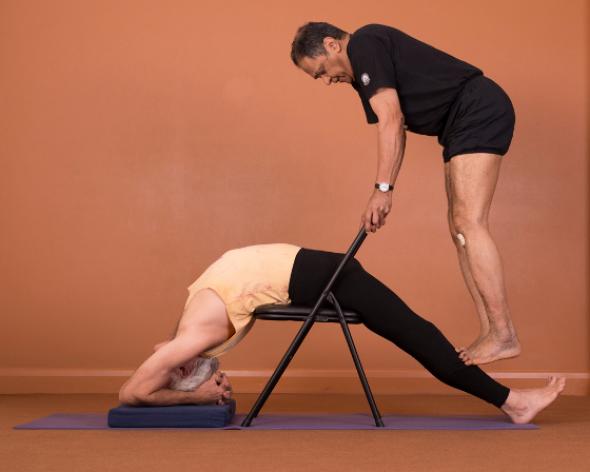
In modern postural yoga, physical adjustments have become a norm. Highly respected pioneers of modern postural yoga paved the way for extreme force being applied to bodies to achieve an idealised position perceived as the correct way to do a pose. When yoga becomes gymnastics, when it shifts into the realm of competitive sport, when it becomes ambitious, misjudgement can come in, clear discrimination can dissolve.

The ambition to be "best"

The visual representations of yoga on magazine covers and on yoga memes almost always depicts postures with considerable wow factor. "Good yoga" is identified as being able to bring the body's joints into extreme flexions and extensions, and to be able to hold the body's weight on the hands or even on on one hand.

Many yoga classes perpetuate this idea. When a yoga teacher has bought into that ideal, and perhaps has a body type that is capable of getting into some of the postures, has perhaps trained in a system that lauds such postural work, then the culture of the class is to work the body to achieve the ideal. I've been there, in my youth, the idea of sitting in lotus posture seemed so important, that I worked my legs quite forcefully trying to achieve it. What did I get from it? Injuries in my ankles, and in my sacroiliac joint. 

So with an ambitious culture, students are encouraged to self harm.

Injury caused by adjustments


Have you ever received an adjustment in a yoga class that injured you? I have. I was doing my teacher training at the time, which made what happened even more shocking. The teacher who made the adjustment was a recent graduate of the same training, so I have a fair idea of the principles under which she was trained. In that training I was hearing messages about asking for permission before touching, about the unique structures of the human body and how one size never fits all. In this class, the teacher approached and without asking permission, pushed my pelvis to force "alignment" according to her ideas about what that should look like. I hurt for a week. To my horror, she showed up as an unannounced teacher in another studio I attended, ran the same lesson plan and tried to do it again! 

Now I refused that adjustment the second time because I saw it coming. I had quite a while to prepare myself to say no. I was also empowered by what I was learning in my teacher training. I knew that it was not OK, and that I had the right to say no. The problem was, the first time, I had no opportunity to give or withhold consent.

Informed consent

Informed consent implies two things. Firstly, that the person understands what is being consented to and secondly, that given that understanding, clearly says yes, feely and unpressured.

In the case I have related above, the first time, when the adjustment was made, it came out of the blue. We were asked to line up with our backs to the wall, place our feet in a particular position, and do triangle pose, with our lower hand right down to the ankle. The teacher then went around and pushed everyone's pelvis against the wall. I was first. I was not asked if I wanted an adjustment and I was certainly not told what that adjustment would be. There were at least twenty people in that class, and the teacher progressed around the room doing the same adjustment on everyone. You could argue that after the first few, if people were paying attention, they would have known what was coming. But nobody was then asked if they wanted to receive the adjustment. There was no culture established in that class that people were permitted to choose not to receive the adjustment. 

On the second occasion, it just so happened that I was last. I watched as the same scenario played out around the room, and when she got to me I refused. Even though I knew my right to refuse and was determined that I should, I spent her whole round summoning my courage to do so and I stated my refusal with more force than the situation demanded because of my nervousness and stress. Afterwards I felt embarressed. I still remember it. Refusing the teacher's adjustment when I was not asked for permission, the stress involved, was not something I could easily forget.

I have also seen a scenario play out in a workshop. The teacher asked for a volunteer, but did not say exactly what was going to be done. I felt uncomfortable when I saw the teacher walking on the volunteer. I wondered about the volunteer's informed consent, but I did not speak up. I wish I had.

When things become inappropriate or even abusive

In the scenario above not only was there a potential physical harm in the "adjustment" and a lack of informed consent, the area of the body was a very personal place. The walking was on the groin. Additonally the teacher was male, and the volunteer, female.

Think for a moment. If you had known this would be the "adjustment" would you have consented?

The peer pressure and class culture can make it hard to say no, and can even persuade you to participate. If I felt uncomfortable with the first volunteer and her experience, I was amazed at the number of additional volunteers who queued up for the adjustment. 

What a strategy - get the first person to receive an inappropriate manipulation by a total lack of informed consent, thus normalising it, and then they will queue.

And we need to navigate that. It is not easy. It is not easy as a student, if a teacher you respect begins to behave in a way towards you that makes you uncomfortable. It is not easy in a teaching fraternity to call the behaviour we may suspect we are witnessing.

First step - Being safe with ourselves

It is an important lesson to learn on the yoga path, that we should be able to feel safe with ourselves. I will perhaps write a whole blog post about this another day. However, without the ability to feel safe with ourselves our ability to open to the truth of who we really are might be hampered by fear. In the context of not doing ourselves harm we must always keep any promises we make to ourselves.

Empowering yourself and others


In conclusion, we owe it to ourselves and to all others to be brave. Brave to say no, and brave to call it out when we see it. Doing so will empower us all. And if any feeling of "oh oh!" arises, trust it, don't suppress it. Step back from the situation, say, to yourself and everyone else, this does not feel right. This is truly courageous, and it helps to have planned it ahead. 

How to recognise the true teacher? 


You will not feel afraid. You will feel empowered, never knocked down, encouraged to independence, not dependence. The true teacher will stir your quest to learn, but never claim to be the sole source of the answers. 


Photo credits: Images of yoga adjustments are from the blog yogamarie.weebly.com and mariehallagerandersen.weebly.com/ and were accessed on 2 December 20.

Thursday, August 6, 2020

The thought: "I"

 Have you ever noticed how "I" attaches itself to everything?

For example, it is cold. Immediately there is a thought, "I am cold".

What is the opposite of "I"? The answer might come up as "you", but it is more like anything that is "other". Can you see how "I" is the fundamental separator, dividing experience into what is this body/mind and what is everything else. The "I" thought is the duality thought. 

It comes online around two years old, and it is no accident that this is the age at which childen are really beginning to acquire language, the ability to communicate thought. Without getting into the complex linguistic and psychological hypotheses around this point, language seems to express thought and thought also seems to be shaped by language. 

To illustrate that take this example. I have heard that Inuit languages have many, many words for ice and snow. They live with ice and snow, and have developed more nuanced thoughts about ice and snow, so have more words for ice and snow to express that. In turn, learning their language, that subtley of thought about ice and snow are readily available to them because the language describes it that way.

I digress. The point really is that we have a word, "I" that refers to this body/mind and separates this body/mind for all others. Cutlurally we learn that as we develop. Psychologically it means we develop an ego, a sense of self. And it is pretty darn handy too. We can possess things, we can tell mine for yours. But pause for a minute and consider. It is just a thought!

In our thought processes we give "I" regal status. It owns everything. Whatever happens, I will take almost immediate possession of it.  Even on the meditation cushion, entering a state of Pure Awareness, which by definition is a no-thought state, and there it is: I am aware, As soon as it happens, that's a thought and we are no longer in Pure Awareness. Damn!

I-ness is a great cause of suffering. "I" gets upset whenever its expectations seem thwarted. Watch your moments of conflict. "Other" does something not in alignment with the way "I" would like it, and suffering happens. It is a resistence of reality. 

This ego-identity is also the source of self-images and beliefs, like "I am fat", "I am right", "I am not enough". In fact the ego-identity is nothing more than a whole bunch of I statements. "I am <insert name here>", "I am <insert job here>", "I am <insert position in family (mother, daughter etc.) here>". The ego-identity suvives by the strength with which we believe these statements. 

The ego-identity that the "I" thought represents is defined by Christopher Wallis in Tantra Illuminated (p. 130) in this way:

Ego ... is a persistent contraction of awareness in the form of a collection of self-images that causes suffering through artificial self-limitation.

 Non-dual spritutual awakening requires a loosening of the power of the "I" belief. Many spiritual traditions talk about this ego falling away, viewing it as an enemy. Of course anything that is being rejected, or that we have an aversion to will keep on coming around. 

Richard Miller, creator of iRest®, often talks about self falling away, but he counsels that it will not happen if you do not feel safe with yourself. (Received in in person teaching.) So every promise you make to yourself, keep it. Then perhaps you can go on where the ego cannot go. I find this useful in Yoga Nidra, to take "I" like a little baby, cared for and loved, and place it the cradle of my heart, inviting it to rest there so Awareness can go on alone. Upon return, ego is again assumed, but like the nurse, the police officer etc. put on the uniform of that profession  in order to perform the job, putting on the ego in order to come back into the world, but it is seen through as a kind of ruse. 

Of course, in iRest we also work on the "I" beliefs, challenging ourselves to take their opposites, and bringing them back to the body. Gradually the tenacity of these beliefs about ourselves begins to loosen, and the ruse of the ego is again revealed.

In Non-dual Saiva Tantra (NST), everything is an expression of Supreme Consciousness which contracts itself from a completely unbounded state which is full of potentiality, to express itself as the manifest universe. So the tradition teaches that far from denying the go, all that needs to be done is to expand that which is included in the "I" thought to include everything! One meditation to use in starting to work in this way is to place a beautiful object that you value before you, and meditate on being that object, of including it in your selfhood, by way of a first step in this expansion.

NST also offers us practices where we "burn" away all our self constructs, emptying ourselves for the light of Awareness.

One of the simplest approaches is to just notice the "I" thought attaching itself to everything. See what happens.

Thursday, May 7, 2020

Surrendering to not knowing

These past couple of months have been extraordinary. The world shut its doors against the COVID-19 virus. And we cannot see the future.

There has been a lot of talk going around on social media about people needing to find things to do to while away their time in isolation. Personally I haven't had time for any of that. I have been busier than ever bringing the studio into an online state, battling technology, helping staff and students battle technology, dealing with change at every turn, being frightened.

Frightened of what? For me, not so much of the invisible virus, but of the impacts to our wonderful yoga studio, our yoga community, our neighborhoods, our livlihoods.

Part of the challenge has been that we cannot plan for this. We do not have a set period that we can expect this to go on for, and hey presto, by such and such a date we will all be back to normal.  We cannot even be sure what normal will be on the other side of this pandemic. Even today as I write we are awaiting the results of todays National Cabinet wondering if maybe we can start going out again soon, maybe the studio can open again soon, as they plan to ease restrictions. But we don't know, and we do not know if we might have to close again if the dreaded second wave comes.

Isn't it so that the not knowing is one of the hardest things? When we recognise that we radically DO NOT KNOW we become aware that things are not within our control. But here is the thing. They never are! All this so called knowing, based upon the predictability of so-called "normal" is pretty much an illusion.

Vidyā - the veil of limited knowing

Of course it is not that we don't "know" anything. The power to know is an innate power of Consciousness. It is the limitation of that power of knowing that we are encountering in life, and that is what is scaring us.

We can understand this limited knowing, vidyā, as one of those limitations that Consciousness takes on in order to become immament, in order to manifest as us and everything we perceive. It is the limitation of the power of Consciousness known as jňāna-śakti.

Vidyā is constantly pointing us back to jňāna-śakti. In the words of awakened spritual teacher, Adyashanti:
"The door to God is the insecurity of not knowing anything. Bear the grace of that insecurity and all wisdom will be yours."

Surrendering to the limitation of knowledge

Well that is all very well for Adyashanti, awakened person, to say, you might be thinking. But this is exactly one of those times we can use the situation that is current in our lives to practice and potentially learn something really deep.  And Adyashanti is pointing directly at it. "Bear the grace of that insecurity" he says, by which I take to mean a surrendering to vidyā, not fighting it, "and all wisdom will be yours".

Wisdom is a kind of greater knowing, a wordless, conceptless knowing. In Sanskrit, widom is a translation of jňāna. What Adyashanti is pointing to is a great potential for breaking through the veil of our limitations to be more intimate with Consciousness itself, that which he has called God in this quote.

Noticing the difference between grasping to know and surrendering to not-knowing

Take a moment to sit. Be still. Be quiet.

Connect into your plans for the future. They do not need to be big plans, they might be a plan to log on to do a yoga class tomorrow, or to take a walk to the coffee shop to pick up your take-away. As you do so, feeling your way, sense the resonance of the thought plan, to do a yoga class or walk and pick up coffee or whatever it is. Take your time with this, especially if feeling the resonance of a thought is a new thing for you.

Stay with that resonance for awhile.  Feel into the assumed certainty that you will take that online class or that walk with the coffee stop. What does that certainty feel like. Beyond the thought construct, find the feeling in the body.

After a little while begin to shift your attention to all the things you don't know - not knowing when you could take a yoga class back in the studio, not knowing how we will recover economically as a nation, all the "not knowings" that are here right now, whatever they are.

And sense into the feeling of it all in your body. Beyond the concept and beyond the emotion of fear and uncertainty, find the feeling tone in the body.

Allow yourself to welcome that feeling tone, to settle into it, to relax into it, to love it for its own sake. This is not a trying, it is an allowing. Surrendering.

Staying with this, surrendering to this insecurity, to this entire feeling of not knowing. Stay with it. stay with it.

The longer you can stay with it, the more fully you are able to surrender, the greater the potential for the blossoming of wisdom.  Which, by the way, may not be a bolt of lightening, but a simple, settled grace of deeper knowing than the mind could ever have.


Thursday, March 12, 2020

Calming and strengthening in difficult times

At WOMAD last weekend, I had a number of instances of discovering that people from different circles, and not even necessarily residents of Adelaide, were connected to each other in some way. So I appreciate the enormous task that the health authorities have when it comes to tracking down the people who have been in contact with people who have tested positive to COVID 19, and all their contacts. We are so interconnected. A virus's dream! And also our own, as a sense of connectedness is one of the most important things to our mental health.

Of course connectedness is the truth of all Reality, streaming forth as it does from one source "on the 'canvas' that is Herself"*. So our sense of connectedness is a little bit of ourselves recognising the truth and coming home to it.

Today I want to offer many ways your sadhana (yoga/spiritual practice) can support you and all others during these tricky times. It is true to say that when we are under pressure we have more tendency to grow and evolve. So if Corona Virus is making you think more about what you do and what you expose yourself to, use that to deepen and double your sadhana.

A strong energy body is a stronger immune system

Many yoga practices will assist you in warding off disease. Certainly practices that are aimed at your physical fitness will help - a fit body is always going to be better placed to resist disease. But I am referring to practices that build your energy body in other ways.

Breathing practices, practices that directly bring you into experiencing and working with your energy body, visualisations and mantra are all going to help you here. And there are practices also that you can utilise to assist others as well.

One great way to bring sadhana into daily life is to dedicate everything you do to the benefit of all beings. Start your day with the mantra lōkāḥ samastāḥ sukhinōbhavantu meaning May all beings in every realm be centred in happiness and joy, free from suffering and centred in the state of unified peace! May it be so. Listen to it here so you can learn it. It is easy.

Dedicating yourself and everything you do to the benefit if all beings in this way has an immediate impact on your state of mind, and it aids you in cultivating discrimination in all you do. It also navigates the mind away from fear and into a state of loving kindness.

Add on visualisations

There are many visualizations that you could use but I'd like to share this one with you that I have been practising for years. It once helped me heal from a very serious injury. Always frame this visualization in a way that will be personal to you. For example, you may have a personal relationship with a deity and could use the visualization of the deity as the golden light described below.

I like to do it this way.

Above me is a golden light. It is full of healing. As I inhale, the healing energy flows down and into my heart. As I exhale it spreads out into every corner of my body. If I have a particular part that needs healing, I will direct it there especially. After a few minutes, I am so full of healing light I can send it out into the world. The golden light above is infinite, and this process can go on forever, and nothing will be depleted, only filled.

Make hand-washing a sadhana

Since you will be spending more time washing your hands, spend every hand-washing with a mantra and it too becomes yoga. You need to spend at least 20 to 25 seconds on your hand soaping right? Three rounds of the lōkāḥ samastāḥ together with the Oṃ śānti śānti śānti will time it right. Or you might use the mahāmṛtyuṃjaya mantra which is powerfully healing.

Yoga is more essential than ever

Your yoga practices are more important then ever. Don't skip your practice because you are feeling fearful or stressed. Double it. Yoga will antidote your fear and literally build your resistance to disease. It may surprise you also that more than your physical yoga, thought that is also helpful, but your meditation, mantra japa, energy body work will build the system's resilience far more.

May you be peaceful and happy. Om.

* Quotation from the Pratyabhijñā-hṛdaya of Kṣemarāja verse 2 translated as the Recognition Sutras by Christopher D. Wallis.


Wednesday, February 19, 2020

Limiting the limitless - pointers to your True Self

The Kaňcukas part 2

Last month I wrote about the five Kaňcukas, which are like veils that limit the vast perfection of the Divine Everything so that it takes form as the diversity that is the manifest universe. Today I will say a few words about each of these.

But first, it is important to note that these limitations, though they lie like veils over our true nature concealing to ourselves the vastness of who we really are, they are not something to be despised or something we need to be rid of. Everything is to be welcomed on this path. And the wonderful thing is that the very aspect that is a covering is also a clue, even a portal through which we might find our way home.

This article refers to the way we can use our iRest® Yoga Nidra meditation practice to help us work with the Kaňcukas. If you are unfamiliar with iRest please visit www.irest.org/ to learn more.

I am also indebted to Christopher Wallis for assisting me in understanding the Kaňcukas and I recommend the relevant section of his book Tantra Illuminated. He explains it far better than I ever could.


Limited agency Kalā

The first step on this path of creation is the limitation of omnipotence (the Divine power of action, which is limitless). The most important thing to note about this is that it does not make us powerless in our embodied form. Kalā is not impotence. It is indeed the Divine power of action itself, just a little pared down. 

Our spiritual path is to nurture and grow that divine Power until we finally realise our full and innate divinity.

In practice, this will mean that when we encounter the power of action in its limited form we have an opportunity to expand it a little. This is why they are pointers.

So meeting “there is always more needing to be done” and my urge to do more, I can also recognize the divine power of doing that brings all of this manifestation to being and dissolves it all back again. If I meet the feeling of powerlessness, can it point me to the feeling of potency? And while we might see these as two opposites in the movement of emotions in awareness, just as we come to know welcoming, and wellbeing as aspects of awareness, so too both omnipotence in its fullness, and its self-limiting form we experience in embodiment are ultimately aspects of that one consciousness as well.

Limited knowing - Vidyā


The limitation of knowing – Vidyā, is not ignorance. Māyā conceals the fullness of omniscience in order to project Consciousness into manifestation.


We are granted the ability to know something about our world and to continue to learn more about our world. The biggest trap of Vidyā is not the urge to know more, it is thinking that what you know is all there is.


The old story of the blind people and the elephant illustrates this.

“A group of blind men heard that a strange animal, called an elephant, had been brought to the town, but none of them were aware of its shape and form. Out of curiosity, they said: "We must inspect and know it by touch, of which we are capable". So, they sought it out, and when they found it they groped about it. In the case of the first person, whose hand landed on the trunk, said "This being is like a thick snake". For another one whose hand reached its ear, it seemed like a kind of fan. As for another person, whose hand was upon its leg, said, the elephant is a pillar like a tree-trunk. The blind man who placed his hand upon its side said the elephant, "is a wall". Another who felt its tail, described it as a rope. The last felt its tusk, stating the elephant is that which is hard, smooth and like a spear.” (Wikipedia's version)


Each thought that they knew what an elephant was, but when they shared what they knew with each other they fell into arguing.
Image credit, medium.com


And this is the trap of Vidyā we see played out in life. This is the human tendency to believe our own limited subjective truth and to ignore, dismiss and even repress the limited subjective truth of others.


In terms of our personal spiritual path, we may fall into a trap based on a limited experience of thinking that we’ve “arrived”. So part of our path is to always seek to expand our understanding.

In fact the manifestation of “Vidyā” of believing “There is more I need to know” is to be welcomed as it keeps us questing.

Vidyā is nothing but the limited form of the divine power of Knowing, jňāna-śakti. As we expand our horizon of limited knowing we more closely approximate towards jňāna-śakti.

Ultimately of course we seek to move beyond words and thinking to the knowing that is an inner wisdom, a lifting of the veil of Māyā to sense that which all the words of teachers, live or in writing, ancient or modern, can only hint at, though they may point the way.


In practice – what we think we know is what we believe. In our quest to expand our knowing, we are seeking to situate what we know in a wider context. In iRest®, our practice in the realm of beliefs does just that. If I am believing “I am a failure, everything I do just turns bad, I have the touch of death for any enterprise” and I come up with all sorts of memories to support that, and I wallow in all the emotions of that, I can use the iRest process to expand that and situate in a broader context, allowing me to move beyond it. I can do that by work in the opposites, what is the opposite or alternative to “I am a failure”? We can work with it anthropomorphically – if this belief walked into the room what would it be … can you dialogue with it. Substitute any belief … “my religion/atheism is true and others are wrong, even evil”, “my politics are the best, the other mob are dangerous”.


The limitation of perfection - rāga - desire


 When the veil of Māyā limits the divine powers, divine perfection is thus limited, and in our embodiment, which is possible only due to all this limiting, we have the sense of not being complete. This leads to desire and craving, raga, as we seek that which will make us feel complete. We misplace the direction of our yearning and crave material possessions, recognition, fame, acknowledgement, food, attention, holidays, physical connection, sex, a different body, and so it goes. We may even fall into addiction to food, alcohol or other substances. If I feel imperfect in this now, in this body, then perhaps if I can get that then I will feel whole. If only everybody paid more attention to me, then I would know I am whole. If only I were 10kgs lighter, then I would feel more perfect. If only I had more money.

In fact all desire, all craving, is the yearning for Divine Perfection, which ironically is already here, just the veil of Māyā prevents our recognition of it. In our work in iRest® we invite connection with what we call the Heartfelt Desire, (though many like to use other terms and that is fine). Eventually we might come to recognise that Whatever we first identify as our heartfelt desire is ultimately that yearning for the wholeness of Divine Perfection.
Watch for the guises in which desire becomes cloaked by the mind … but I need this. But the other is lacking for not giving me attention. But life is unfair and I deserve such and such.
Other literal meanings of the word rāga are to colour or tint; and a musical harmony or melody.
Desire colours the mind and tints our perspective and influences how we see the world and other people. For example: The desire for attention will see everybody else’s attention as belonging to ourselves and we will become demanding of it, even manipulative to achieve it … and this will colour all our relationships.
In Indian music a rāga is also like a scale, but also like a theme upon which variations can be played. And the musical notes present themselves with dissonance and resolution. The dissonant notes will feel imperfect, they crave a resolution. And then of course the resolution comes and the harmony resolves. That dissonant note is the craving for fullness.
Desire, rāga, shows us areas where we may need to expand ourselves more fully. Self-inquiry, as in meditation but also in reflection, can reveal our cravings. OK if we have a craving for peanut butter that is easy to identify, but truly recognising something like our craving for attention may require us to open our eyes somewhat, to be come more self-aware in the small s sense. 


Rāga is not to be rejected, but transmuted.
  • Recognise desire, truly
  • Trace desire back to its source
  • Recognise your yearning for divine fullness
  • Allow that yearning to guide you home – you are just following the perfume!

The limitation of time - Kāla

From the timelessness of Pure Consciousness, linear time is a requirement of embodied experience. In pure Consciousness everything is simultaneous, but as embodied beings we experience one moment after another.

Our awareness of linear time also gives us the sense of past and future. Our sense of the past can make us feel guilty, regretful and also nostalgic. Our sense of the future can make us fear, worry, and also fantasize.

It is easy to appreciate the burden of guilt and worry. But less obvious is that nostalgia and fantasy are a burden. But we are grasping at both, attached to both and in that attachment we are missing the middle point.

Poised in the middle is the present moment, so much eulogised in our age of mindfulness practices.
It is the sense of linear time that seems to be the distinguishing mark of the human animal. Do the animals fret with guilt over their past failings or with worry over the potentiality of the future. Do they have nostalgia or do they fantasize?  Well we cannot know for sure but it appears not. Yet the mindful now we humans seek is not that of the animals. It is in our reflection on the past and anticipation of a future that we find a potential for evolution, for growth.

We seek to stay in the present with full awareness of guilt and nostalgia, worry and fantasy, all the while being free of them. Again, the limitation of time, manifesting as guilt or anxiety, nostalgia or fantasy, is welcomed as the pointer to the state of Presence. – The present which constantly flows, is constantly flowing from Consciousness and unfolding as manifestation and is simultaneously reabsorbed into Consciousness.

We can invite the law of opposites to guide us, working with pairs such as:
  • Guilt and nostalgia
  • Fantasy and worry
  • Fantasy and nostalgia
  • Guilt and worry
  • Nostalgia and worry
  • Fantasy and guilt

The limitation of space - Niyati


Niyati is very interesting. It is the limitation that results in us experiencing individuality and separation.

Pure Consciousness has no dimension. You may have experienced this immense spaciousness. In iRest we often ask the question: is there any centre, is there any periphery, inviting the discovery of, no there is not, there is everywhere-ness and nowhere in particular-ness.

(Richard Miller, creator of iRest, has said that that expression he uses so often, everywhere and nowhere in particular, was how one veteran in one of the early PTSD trials at Walter Reid described it, and he picked up those words as being the best representation he had come across.)

Niyati creates the three dimensions of space, in which materiality is possible, and in so doing the sense of location, of having centre and periphery, comes about. And since we also have the sense of not being able to occupy the same space as anything else, the sense of separation arises. Niyati then is the restriction of the formless transcendence that is Śiva itself!

In embodied life we constantly experience niyati by the very sense of our body as a spatial location. We also experience frustrations of space, not having enough of it for example, or the space we occupy not being good enough.


Everyday practice is to reorient ourselves to all our actions being in selfless service. This might seem tricky when we meet our pure motive prayer, I practice out of love for myself, out of a desire to know the truth … until we refine our understanding that it is only in the sense of separation created by niyati that we have a sense of ourself at all, and to serve ourself is to serve all others. HOWEVER, that does not really let you off the hook. In loving yourself, you need not seek endless fruits for yourself, and the more you ardently discover the Truth, the less that is seen as a true goal. And in the prayer for pure motive, it is underpinned by “for the benefit of all beings” which immediately removes “selfish” motive.

In meditation we invite an experiential welcoming of Consciousness – Awareness – as unbounded spaciousness.

That can also be a micro meditation for anytime. Just stop. Expand. Touch into that spaciousness, even if just for a moment.

It is like the dyer dying the cloth. To obtain a really rich colour the cloth goes in and comes out. Then it will go in again, and out, and in again, and so on until the colour is at the rich hue required. So too we are dipping into pure spaciousness, again and again. Eventually we are saturated with it and it never leaves us.


Go to Part 1

Tuesday, January 7, 2020

The five pointers - Kaňcukas

Part 1

Learning never ceases. I am constantly looking for guides from whom I can glean more gems from the yogic path.

I have recently done an online course with a beautiful and stunningly intelligent woman by the name of Kavitha Chinnaiyan … cardiologist, and lineage holder in the Sri Vidya lineage. During the course she explained that to ascribe gender to siva and sakti is only a device, that gender cannot truly be ascribed to them as they are but aspects of oneness, that even to use such a term as oneness, implying as it does that there is a more than one, does not do justice to That which we seek to describe. She also gave a powerful image of how the world becomes manifest – as sakti turns to face siva, manifestation dissolves into the still spaciousness of siva, as sakti turns away manifestation occurs, and sakti turns and turns, like the blinking of an eye, so there is a pulsation in this manifestation, a throb, a vibration, we do not usually notice it, manifestation seems continuous, just like when you run the individual frames of old fashioned analogue film through the projector, the world on the screen seems continuous and you do not see those moments in the frame where there is no picture. This vibration is called Spanda.

But the View writings reveal more detail about how this manifestation occurs.

Kaňcukas: concealments for manifestation


In this process there are five concealments that mask our oneness. These concealments are necessary in order for that which is unlimited to take form. In Sanskrit they are called the Kaňcukas, in iRest®, Richard Miller dubbed them “the pointer sisters”. I will come back to the reason why.

The concealments, or limitations, are:
  1. Kalā – limited agency (or doing)
  2. Vidyā – limited knowing
  3. Rāga – limited perfection = desire/craving
  4. Kāla – limited time – sequential time, divisions of time, passing of time
  5. Niyatī – limited space – localisation and causality

We can easily see these in action.
  1. There is so much more I need to do.
  2. There is so much more I need to know
  3.  I so much crave that … < insert latest craving here> (holiday in Bali, new car, chocolate bar, better body)
  4. I just don’t have time, am running out of time, I have a past, I anticipate a future
  5.  I don’t have enough space, I need a bigger house, closet, kitchen etc – or I am too big, I am too small, I am in the wrong city, I am not happy unless I am at the beach etc

iRest® founder Richard Miller calls them pointer sisters as they are like signposts with an arm pointing both ways.

  • This way – manifestation, embodiment and the sense of being incomplete
  • That way – lifting through the veils to recognition of true nature as always whole, nothing needing to be done, omnipotent, omniscient, perfection, eternal and infinite.

Between recognition and the Kaňcukas of limitation is Māyā, laying like a strata of cloud that conceals the sun. 

Have you ever had the experience of taking off in a plane on an overcast day? The plane leaves the ground in dull conditions and enters the cloud and things are even duller. Then there is a moment when the plane breaks through the cloud and you find there is brilliant sunshine above the clouds.

Our perception is like that. When embodiment happens and a sense of I develops, that "I" loses the sense divine Oneness and feels separate and different to everything else. This is like living in dullness. When you break through the clouds you awaken to the brilliance of non-duality. Sink below the clouds and and you are in the realm of limitations and a sense of separation.

So they are pointers because as we can recognise them as they are present in our lives we can also take them as reminders or pointers to who we really are.

These limitations are never a voiding of the unlimited attributes of the Divine Oneness. The limitation of infinite power is not impotence. It is just enough of a limitation for dimensions and linear time and action to be possible, preconditions to manifestation and embodiment. So meeting the Kaňcukas is not to be despaired at, nor are they to be rejected. You are not trying to get rid of them, just to recognise what is on the other side of that strata of clouds, Maya, and what these pointers represent!

Try this sadhana, spiritual practice, you can take it on for a week, a month or forever; notice the action of the Kaňcukas in your life, and you might journal how they affect you and reflect on how they might be pointing you to your true self.

In Part 2 we will look at each of these in more detail.