In a yoga class we should be able to feel safe. Yoga as a practice of body/mind/spirit integration cannot be effective if we do not feel safe. Learning does not take place if we do not feel safe. Yet there are many ways we may not feel safe, and may not be safe in a yoga class.
Ahimsa - non-harming
In the classical yoga of Patanjali's Yoga Sutras, the principle of Ahimsa, non-harming, is the first yama of the five ethical practices that comprise the first limb of yoga. If yoga is truly adhereing to this principle, we would be safe in yoga classes.
Ahimsa encompasses not only not harming others but also not harming ourselves. In the contect of not hurting ourselves in yoga classes, I believe we may lose some of our agency due to the culture of the class.
Safe from physical injury
In modern postural yoga, physical adjustments have become a norm. Highly respected pioneers of modern postural yoga paved the way for extreme force being applied to bodies to achieve an idealised position perceived as the correct way to do a pose. When yoga becomes gymnastics, when it shifts into the realm of competitive sport, when it becomes ambitious, misjudgement can come in, clear discrimination can dissolve.
The ambition to be "best"
The visual representations of yoga on magazine covers and on yoga memes almost always depicts postures with considerable wow factor. "Good yoga" is identified as being able to bring the body's joints into extreme flexions and extensions, and to be able to hold the body's weight on the hands or even on on one hand.
Many yoga classes perpetuate this idea. When a yoga teacher has bought into that ideal, and perhaps has a body type that is capable of getting into some of the postures, has perhaps trained in a system that lauds such postural work, then the culture of the class is to work the body to achieve the ideal. I've been there, in my youth, the idea of sitting in lotus posture seemed so important, that I worked my legs quite forcefully trying to achieve it. What did I get from it? Injuries in my ankles, and in my sacroiliac joint.
So with an ambitious culture, students are encouraged to self harm.
Injury caused by adjustments
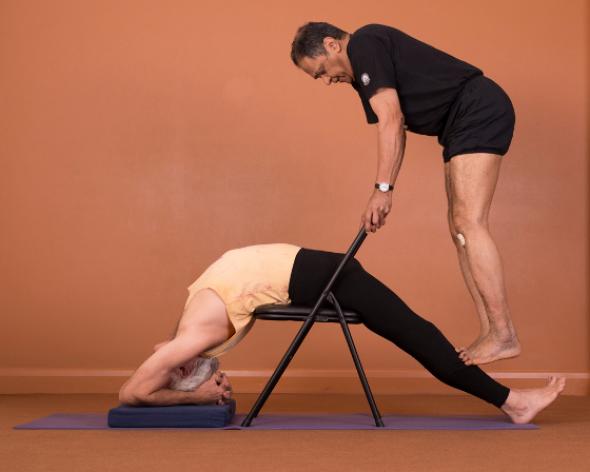

Have you ever received an adjustment in a yoga class that injured you? I have. I was doing my teacher training at the time, which made what happened even more shocking. The teacher who made the adjustment was a recent graduate of the same training, so I have a fair idea of the principles under which she was trained. In that training I was hearing messages about asking for permission before touching, about the unique structures of the human body and how one size never fits all. In this class, the teacher approached and without asking permission, pushed my pelvis to force "alignment" according to her ideas about what that should look like. I hurt for a week. To my horror, she showed up as an unannounced teacher in another studio I attended, ran the same lesson plan and tried to do it again!
Now I refused that adjustment the second time because I saw it coming. I had quite a while to prepare myself to say no. I was also empowered by what I was learning in my teacher training. I knew that it was not OK, and that I had the right to say no. The problem was, the first time, I had no opportunity to give or withhold consent.
Informed consent
Informed consent implies two things. Firstly, that the person understands what is being consented to and secondly, that given that understanding, clearly says yes, feely and unpressured.
In the case I have related above, the first time, when the adjustment was made, it came out of the blue. We were asked to line up with our backs to the wall, place our feet in a particular position, and do triangle pose, with our lower hand right down to the ankle. The teacher then went around and pushed everyone's pelvis against the wall. I was first. I was not asked if I wanted an adjustment and I was certainly not told what that adjustment would be. There were at least twenty people in that class, and the teacher progressed around the room doing the same adjustment on everyone. You could argue that after the first few, if people were paying attention, they would have known what was coming. But nobody was then asked if they wanted to receive the adjustment. There was no culture established in that class that people were permitted to choose not to receive the adjustment.
On the second occasion, it just so happened that I was last. I watched as the same scenario played out around the room, and when she got to me I refused. Even though I knew my right to refuse and was determined that I should, I spent her whole round summoning my courage to do so and I stated my refusal with more force than the situation demanded because of my nervousness and stress. Afterwards I felt embarressed. I still remember it. Refusing the teacher's adjustment when I was not asked for permission, the stress involved, was not something I could easily forget.
I have also seen a scenario play out in a workshop. The teacher asked for a volunteer, but did not say exactly what was going to be done. I felt uncomfortable when I saw the teacher walking on the volunteer. I wondered about the volunteer's informed consent, but I did not speak up. I wish I had.
When things become inappropriate or even abusive
In the scenario above not only was there a potential physical harm in the "adjustment" and a lack of informed consent, the area of the body was a very personal place. The walking was on the groin. Additonally the teacher was male, and the volunteer, female.
Think for a moment. If you had known this would be the "adjustment" would you have consented?
The peer pressure and class culture can make it hard to say no, and can even persuade you to participate. If I felt uncomfortable with the first volunteer and her experience, I was amazed at the number of additional volunteers who queued up for the adjustment.
What a strategy - get the first person to receive an inappropriate manipulation by a total lack of informed consent, thus normalising it, and then they will queue.
And we need to navigate that. It is not easy. It is not easy as a student, if a teacher you respect begins to behave in a way towards you that makes you uncomfortable. It is not easy in a teaching fraternity to call the behaviour we may suspect we are witnessing.
First step - Being safe with ourselves
It is an important lesson to learn on the yoga path, that we should be able to feel safe with ourselves. I will perhaps write a whole blog post about this another day. However, without the ability to feel safe with ourselves our ability to open to the truth of who we really are might be hampered by fear. In the context of not doing ourselves harm we must always keep any promises we make to ourselves.
Empowering yourself and others
In conclusion, we owe it to ourselves and to all others to be brave. Brave to say no, and brave to call it out when we see it. Doing so will empower us all. And if any feeling of "oh oh!" arises, trust it, don't suppress it. Step back from the situation, say, to yourself and everyone else, this does not feel right. This is truly courageous, and it helps to have planned it ahead.
How to recognise the true teacher?
You will not feel afraid. You will feel empowered, never knocked down, encouraged to independence, not dependence. The true teacher will stir your quest to learn, but never claim to be the sole source of the answers.
Photo credits: Images of yoga adjustments are from the blog yogamarie.weebly.com and mariehallagerandersen.weebly.com/ and were accessed on 2 December 20.


