Thursday, December 12, 2019

Joy

"I slept and dreamt that life was Joy. I woke and found that life was service. I acted, and found that service was Joy." ~ Tagore
It is December and Christmas carols are everywhere. "Joy to the world" they sing! Yet in the yogic understanding of who we are, joy is always here, it is a part of the fabric of our being. That is, if we translate the word "ānanda" as joy ... it might also be bliss, or maybe rapture.

My parents gave me Joy as a middle name. As my meditative life has developed I find that central position of Joy in my name to be just how it is. Through meditation I find that Joy is at my centre. Even on a bad day I can stop a moment and reconnect to it.


Joy in the yogic traditions


Yoga philosophy is full of models of our nature to help us find our way to the truth about ourselves. These models can differ from one tradition to another and so it is with the concepts of the self as layers, the Vedic system differs from the Tantric system. But both have something to offer.
Ānandamāya is in the most subtle layer in the Vedic kosha system and in the iRest Protocol. 


My own drawing of the five koshas, modelled on numerous other sources

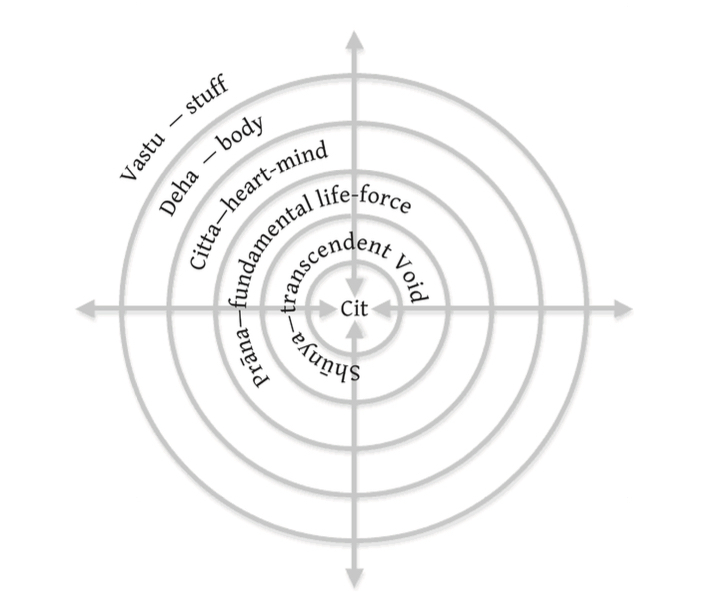
Tantric five layered self from https://hareesh.org/blog/2015/12/16/the-five-koshas-and-the-five-layered-self-a-comparison

 In some representations of the Vedic kosha system ānanda is the centre, seen as the goal, the ultimate, in others, such as the one top, above, it is still a layer, subtle but still a sheath or covering on true nature.


Ānanda, Joy, is not present in the Tantric five layered self, but that is not to say that Bliss, Joy, Ānanda is not very important in the Tantra. Ānanda is different from temporary joy that comes from sense pleasures, though such pleasures can help us glimpse it; ānanada is bliss that is an aspect of the completeness of pure Consciousness.

 It is therefore is not attained by any technique or study itself; ānanda is not something that is achieved. It is more something that is regained. All the yogic practices are working more to strip away what veiled ānanda not to create ā
nanda.


Life is joy


If there is a season that seems the most joyful it would have to be Spring, wouldn't it? That is because life is springing freshly all around in spring.  I imagine this must be amazing if winter is blanketed in snow and life goes into suspension, bursting forth as Spring thaws the frozen world, the grass grows, the birds and animals are busy mating and giving birth.  But even in Australia it is easy to feel that surge of joyful life in Spring.

When we think of what gives us joy, baby things just have to feature. Who doesn't love watching kitten and puppy videos on Facebook or YouTube ... why can we "waste"so much time on them? Because they bring us joy and we so long for that joy. Can you remember holding a newborn baby? Ah! the delicacy, the smell, the joy! It is not by accident that joy is so accessible through baby things, life is renewed in baby things, and life is joy.

I also find that birdsong, and the activities of birds, watching birds is also a call to joy. Do you?

Cultivating somatic awareness, as we do in yoga practice, helps us to connect with our innate joy. When we have developed an acute somatic awareness we can feel the pulse of life in the tissues. The feeling of being alive. And it is joyful. So to connect with joy nothing in particular needs to be happening, if you can feel life in the tissues you can feel joy.

Of course a few memories of kittens, puppies and babies are certainly helpful. They flood our brains with the chemicals that can counteract the woeful chemicals that sometimes block our somatic awareness and keep us locked in a sense of misery. 

The more we consciously connect with our joy, the more open our brains become to the presence of joy, and it becomes a positive feedback loop.

So stop, listen to the birds, watch them, watch those kitten videos, feel the joy, celebrate life. Joy is an aspect of the divine and a part of who you are.


By Tatiana Gerus - originally posted to Flickr as Lorikeet's wings, CC BY 2.0, https://commons.wikimedia.org/w/index.php?curid=6552046

Friday, November 29, 2019

Grace

The iRest® class on Saturday mornings that I started in August 2019 has proven to be a gift of opportunity for deep reflection.  The other week I reflected on grace, and shared those reflections with the class, and then benefited from the class's reflections.  That is the kind of class it is.


Helpful key words are: 
  • Anugraha - divine grace, the grace of universal consciousness pervading everything, that we come to recognise in spiritual awakening
  • Shaktipat - (shakti - divine power, and pat - to fall) descent of grace

It is important to distinguish what we mean by Grace from how it is used in a Christian context, where God's Grace is frequently invoked. The word grace in the Christian context has an intermediary between the recipient of grace and God, it is, as so much of that theology is, a step removed. Grace is spiritual healing granted by God the Father, through the Son, Jesus.

Anugraha has no such intermediary. Shaktipat is direct, often sudden, undeserved. 

Grace, Anugraha, is divine consciousness in everything. It is present in everything because everything is it. We just do not recognise it when we are living in a limited, conditioned state. 

At a point in a spiritual aspirant’s life there will probably be a moment of Shaktipat – when the felt sense of that power of divine consciousness in everything breaks through the conditioned limitations of the mind at least momentarily. It leaves behind a metaphorical perfume the aspirant (if they were not one before they will be now) is bound to follow that scent.

In iRest we invite what we call the Heartfelt Desire to reveal itself. What does our heart yearn? we ask ourselves. What we yearn is that perfume even if only faintly discerned. Grace calls us. 

The writings of spiritual teachers are full of memoirs of Shaktipat.  Vast and amazing moments, perhaps in the presence of seemingly at the instigation of their own teacher, the sudden moments of the revelation of the connection of everything. 

However Grace is not always such a show pony.  There are gentle revelations. Don't dismiss them. 

There is that moment on the beach when the sun is setting. Suddenly the clouds are alight with orange and purple when suddenly the cold snap of wind, the sting of sand and salt, and that colour, are what you are, and while you are no longer separate from any of it, including the potential new boyfriend you have ventured there with, he is no longer of any special interest and when it fades, this moment, and limitations return, that lingering perfume have rendered him uninteresting and you yearn only for that again.

There is that moment when you are walking amongst great trees, trees that have stood for a thousand years. They do not exactly think, and they do not exactly talk, but in their great presence your heart feels that perfume and ancient treeness pervades your being. 

Or that moment when you are simply breathing in deeply the scent of a rose and suddenly scent of rose, the soft satin of petal, and your whole being are one.

An echo stays, lingers, draws you on. Ah, if only to melt in it always, to not return to the mundaneness  of the conditioned mind, to recognise the truth of who you are in every moment. Now you are caught in the quest, it cannot be let go.


Tuesday, October 29, 2019

The heart-mind

We tend to experience our head as being the seat of the mind, which we consider to be the realm of thoughts, whereas our emotions are of a different world, perhaps of the heart. However this is a rather cultural division. Sages of the Indian tradition wrote of the heart-mind. If they wrote of the heart, they meant the heart-mind. If they used a word such as manas, which is usually translated as "mind" they  mean heart-mind. Is this a way of seeing that is useful for us?

It is not hard to experience the interrelationship of thought and emotion. For example, let's say we take a belief that I am not good enough. If you take that belief to be true, what does if feel like in the body. This is just a thought, a belief. But do you feel it in your head, or in the body? What emotions are co-arising as you take this belief to be true? Where in the body do you feel the emotion? Now let's take another belief, let's take the belief I am perfect just as I am. If you take this belief to be true, where do you feel it in your body? And what emotions co-arise with it? Where do you feel that emotion in your body?

You can try this also with memories, images, all kinds of cognitions. Can you have a cognition without a visceral feeling experience, or without emotion?

My own experience is that thought and emotion are always present together, and they always have a feeling right in the body somewhere, often in the chest region, that is, in the heart. Even though I have the cultural conditioning of thinking in the head, if I stop and examine my actual experience, the experience is mostly in the torso of the body, in the heart! Chances are high that I am not unique and this might be your experience too.

So it turns out that English is inadequate to express this, though we can turn it to reflect our true experience with some creativity. In the article I link to below, a Chinese man in a case study who is saying he could not rest, uses an expression that literally translates as I could not put my heart down. To draw attention to our true experiencing we might use expressions like body-mind or heart-mind.

If you have experiences of insomnia, perhaps next time you are laying awake you could amuse yourself by noting the experience in your body, rather than the churn of thoughts being in the head. Perhaps you could experience not being able to put your heart down on such a night. And see how it is an ever changing feeling-scape.

It comes back to somatic experiencing and yoga practice is about somatic experiencing, ever refining our ability to feel into even the subtlest experiences of the body. A slow and somatic yoga practice, whether you flow or hold postures, turning attention inward, reveals it all.


If you are interested, I found this academic article, Thinking Hearts, Feeling Brains:Metaphor, Culture, and the Self in Chinese Narratives of Depression that shows the cultural dimension of where we experience the seat of thought.

Image sourced from another nice article Wisdom is a Matter of Both Heart and Mind Neuroscience.com

Sunday, September 29, 2019

Asking the question, what is true?

Sigmund Freud's posited construct of the mind was tripartite, consisting of id, ego and super-ego. Id is the instinctual drive; Ego is more than just a sense of self, it is the organising aspect of our psyche; while Super-ego aims for perfection and is super-critical, punishing imperfection with feelings of guilt and shame.

I am no expert in Freudian psychology. No doubt if I were I could write a book just talking about these three aspects of self and telling you how Freud's own thinking on them developed. But I am not and I cannot. It is interesting, however, that our common everyday use of the word ego has parted company somewhat with Freud's theory. Ego is the Latin word for I, so we tend to make the word synonymous with our sense of I-ness. What in non-dual tantra might be called ahamkara. 

The word ego is tossed around as if it is something undesirable. As such it is being confused with another term, egotism, which is the state of being excessively self-absorbed. So when we say something like "Oh, he has such an ego!" in that judgy, perjorative way that we do, we are really saying that he is egotistical, that is, self-absorbed. And what a terrible way to be, poor person!

Of course, the self in which this poor person is so absorbed is not that capital S Self that is used as a descriptor for the Universal Consciousness, beyond concept, which is therefore impossible to describe. No, it is the small s self, I, me. It is a thought and a bunch of ideas, beliefs about what "I" am.

Note well that it always another person, never ourselves that we hold this belief about, that they are self-absorbed and egotistical. Yet this belief about another is surely created as a reaction to another belief, that things should be a particular way which make me feel comfortable and this person is in someway violating that and therefore must be wrong, namely, they are self-absorbed. Is it not our own self-absorption that created a belief that things should go our own way that leads to this other belief that another person is self-absorbed.

The message here is that it is all belief, all thought and you just cannot trust it to be in anyway true.

Maps of the territory 

Freud's theory of Id, Ego and Super ego is nothing more than a map or model of the mind and sometimes perhaps its view is useful, but there are other views which might serve us better, sometimes.  It is like Google maps.  We can see the map, the street view, perhaps we might even be able to see a satellite image and so forth. We use the view that is most useful. 

The yoga tradition has also mapped the territory, in many ways, with the purpose of pointing us beyond the mind to the essence of our true nature.

What do we really know is true?

This is the essential question on the spiritual path. In many ways it merges into this other big question:

Who am I?

In answering Who am I? we might come up with all sorts of labels and beliefs. A name? That is a label. A place in a family, wife, husband, mother, father, sister, brother? Are they not labels too? Can a label be true? Do they tell you what is your essence nature?

It can be scary as you begin to peel away all the labels, all the ideas, all the beliefs and begin to recognise them as being quite unreliable, things that in fact feed your own self-absorption. The pathway to Self-absorption is destructive. Big S Self-absorption, which is to rest in your essence-nature, cannot co-exist with small s self-absorption. The moment we fall back into small s self-absorption we are forgetting our big S Self.

Small s self is quite worried about being destroyed and is as adaptable as a super-virus to any attempt to undermine it. But the thing is that it is the absorption that we are overcoming in order to abide in our essence nature. Then we can utilise the small s self to navigate life without being pulled into absorption, simultaneously knowing our true Self, which is so much more!

Practice

If you are ready for this scary journey here are some things you might do.

Practice iRest® Yoga Nidra meditation. Within the iRest protocol you are invited to examine your beliefs, pair them with opposites , notice the emotions that co-arise and trace them into the feelings in the body, pair them with opposites and ultimately recognise that neither is completely true, opening the way for experiencing that which is true.
A handmade notebook with handmade paper, elephant images on its hardboard cover

Another practice is to take a notebook, a pretty one is best, one that you could really value. In it write everything that you think is true about yourself , others and the world. Putting it out there can help you find objectivity and might help the process of taking it into meditation and really examining its veracity. When it is full find an opportunity to ritually burn it. With it burn all attachment to those beliefs.

Surrender

In the end there is no doing, no practice. It is simply being prepared to surrender.

Thursday, August 15, 2019

Beyond duality


Vitarkabādhane pratikpakabhāvanam*
Yoga Sutra 2:33


Translations:

When the mind is disturbed by passions one should practise pondering over their opposites.
Swami Satyananda Saraswati

In order to exclude from the mind questionable things, the mental calling up of those things that are opposite is efficacious for their removal.
William Q. Judge

When distracted by wayward or perverted rationalization, suitable counter measures should be adopted to keep away or remove such obstacles, especially by the contemplation of the other point of view.
Swami Venkatesananda

When negative feelings restrict us, the opposite should be cultivated.
Alistair Shearer


When disturbed by negative thoughts, opposite [positive] ones should be thought of. This is pratipaksha bhavana.
Swami Satchidananada

Cultivating of opposites

The phenomenal world is a world of opposites: Hot/cold, big/little, smart/stupid, black/white, me/you. It is a world of dualistic opposites. It has to be so. Whatever we are experiencing now, the opposite is also here, or at the very least, waiting in the wings. Our thinking is in opposites, our feeling and emoting is in opposites. 

Yoga Sutra 2:33 recognises that we become embroiled in disturbing cognitions and feelings and counsels the cultivation of the opposite. You might ask, if the opposite can always be here too, why do I get caught up in the most uncomfortable of the pair, in distress instead of in comfort? 

This has to do with the way our brain has evolved to keep us safe.  We have a negative bias.  Better that we mistake a stick for a snake than a snake for a stick. What happens though is that we get a bit trapped in the negativity and begin to  suffer.  We believe it, so we suffer.

In this age of the wonders of imaging the brain scientists have now shown how cultivating gratitude for example can change the very structures of the brain, growing the hippocampus and shrinking the amygdala. Cultivation of gratitutde is an example of cultivating the opposite.  When doom and gloom is all around, practice noticing what there is to be grateful for.

Welcoming opposites

The practice becomes even more powerful when we also practice welcoming both sides of the pair, not rejecting that discomforting side, not clinging on to that more comfortable side, but being open to them both.

In the practice of iRest® yoga nidra meditation we do this, moving between the two sides of the pair, welcoming both, whether it is a feeling in the body, such as hot/cold, an emotion and its feeling in the body, such as sad/happy, or a thought or belief, such as I am stupid/I am smart. We always notice how they feel in the body and go between those feelings, not just summoning them as a thought.  What does it feel like to believe I am stupid? What does it feel like to believe I am smart?

Both together

It is when we reach the point where we hold them both together that the really big power moment comes. It is not a merging, but both here together, both opposites at the same time. 

Wow! The resolution opens up to a state that is beyond opposites.  This is a sense of open, welcoming, Presence that is full of equanimity. How so?

Moving beyond duality to the simple way things are

This embodied form incudes all the thoughts, emotions, and every perception that we have, including the me thought. This embodied form is constrained by thought into believing in separation, a me and a you. It is in this state that the opposites arise.

The mind of thoughts is so powerful, and we are so habituated to its illusions, that we need a few tricks if we are to see beyond it and experience another Reality. And one of those little tricks is this work in opposites. When we hold these two opposite constructs of the mind at the same time, we may be able to "see" beyond them to the simple awaring Presence that everything is. 

Everything is. It is not was or will be, it is. 


* vitarka - doubt, discussion, discursive thoughts, passions
   badhane - disturbance, harrassment, torment
   pratipaksha - the opposite
   bhavanam - should be thought of, pondered, state of mind


Thursday, May 16, 2019

Its all about Love

Do you know, do you remember, that feeling of falling in love?

Maybe at first you are just loving someone but they don't know and you can't tell them. So you yearn for them. And you do whatever you can to be near them, to flirt a little, to try and reel them in, so to speak!

Then maybe it all comes together and you get to be with the object of your yearning, and there is that heart full feeling and a feeling of connectedness. When you are apart, there's the yearning again. when you are together, connectedness and heart-full-ness.

Sometimes when apart, you smell their perfume, and the heart aches for them.

Awakening is a lot like that. And it is pure love.


In the first instance there is a glimpse of all that is true, just a glimpse, but it sets the heart yearning.  And whenever you stray or forget, eventually the yearning calls you back to the path. Once you have sniffed the perfume of the Truth, it lingers, you catch it here and there.

As Awakening unfolds, it is pure love in the heart. Eventually love is simply streaming everything into existence from your own heart of love. It is pure love touching into the depths of inner stillness, and pure love generating the entire universe.

Love is fullness. Love is complete. Love is compassion and kindness. Love is expansive.

When I was little I must have asked my mother who God is and she told me "God is Love". I think for her God was out there somewhere loving her, me and everything. In the non-dual View however, there is only God/dess. Awakening is the sublime recognition of that in living experience. There is only God/dess. I am that One, everything is that One. And that One is Love.

All you need is love ....


Friday, May 3, 2019

Metaphors of Oneness and forgetting

Here is a saucepan of porridge. As it heats bubbles rise, pop and blop on the surface. For a moment a crater appears, but it then subsides into the mass that is the porridge. Another bubble pops and blops, and subsides, and another and another.


Here is an ocean. On the surface a wave forms, swells, rolls and subsides back into the ocean. Another happens here, and here and here, all waves arising, forming, swelling, rolling, subsiding.


Perhaps each porridge bubble bursting on the surface thinks, I am something, an individual entity, and here in the porridge pot there are others a bit like me but different.

Or perhaps each wave thinks, I am a something, an individual entity, and here with me there are many like me, but different. They are others.

Imagine that. Imagine if you tried to tell each individual porridge bubble or wave that they were not separate but the same, that they are the porridge, or the ocean.

With the vantage point we have from the porridge and the ocean it is easy for us to see that the bubble and the wave are not separate from the porridge and the ocean, so much so that the suggestion that they are seems laughable.

Yet you and I are the same, and yet we find it very difficult to see that we are the same, just little emanations, here, and there, of the one Consciousness. This is the great discovery of non-dual Awakening. There is no separation between anything, it only seems so because we are caught up in a separateness of functionality we sometimes label as ego. Or call it I-ness.

This is no baseless postulation, or insubstantial philosophical musing. There are many who have fallen out of the illusion of separateness, sometimes accidentally, sometimes having made themselves accident prone through their spiritual practices. It is more common than you might think to have had such experiences, even momentarily or for just a little while, of recognising that everything is non-separate, and how the ego simply functions as a tool. It is an unforgettable experience, it changes how you see things, even if the tenacity of identification with the I-dentity reasserts itself, it no longer enjoys a total eclipse of Oneness. Once you've seen it, you cannot really un-see it. You know it, even while you are forgetting, and re-identifying with being a separate I.

A little more uncommon is the experience of waking up to that realisation permanently when the person permanently sees through the functionality of the I and fully feels the flow of one consciousness in everything. We call those people Awakened.

Our bubbles and waves are also metaphors for everything that is coming and going in our experience, be it a sensation, a feeling, emotions or thoughts. They too arise, unfold, perhaps they stay awhile, but then they subside, back into that from whence they came, that One Consciousness. Recognise that and you are already well on the path to recognising everything.

This Vedic verse (Brihadaranyaka Upanishad) prays for that recognition, that awakening:

Om asato mā sad gamaya,
tamaso mā jyotir gamaya,
mṛtyor mā amṛtaṃ gamaya,
Om shanti~ shanti~ shanti hi~~

Om - Lead me from un-truth to Truth
Lead me from darkness to Light
Lead me from death to Immortality
Om peace, peace peace

In the non-dual interpretation, the un-truth, the darkness and death is our forgetting our True Nature. As that One Consciousness, though the body may die, that One Consciousness that we are, manifesting in apparent mortal multiplicity, is in fact immortal.