Tuesday, June 2, 2015

How to catch a monkey


  • Take a coconut and drill a hole in it just big enough for a monkey's open hand to fit through.
  • Tie the coconut down to the ground
  • Put something inside the coconut that the monkey will find irresistible, such as peanuts or banana
  • Wait
The monkey will soon come along and reach inside the coconut to grab the delight inside. But with his fist firmly around the treat he is unable to draw his hand back out. The monkey is most reluctant to let go of the treat and remains trapped!

This simple method of catching the monkey is a parable for our own suffering. Our attachment keeps us trapped in the condition of suffering.  Just as the monkey would only need to let go of the bait to be free, all we need to do is to release our attachment.

The Buddha gave the three causes of suffering to be attachment, anger and ignorance.

Patanjali, who wrote the "Yoga Sutras" lists five causes: ignorance (of our true nature); our ego, which defines us as many things, but blinds us to our true self; attachment, like the monkey; aversion or resistance, which is the flip side of attachment; and, fear of death. 

We are advised by the sages to still the mind. I suspect that this is even harder for modern people in the information age to do than it was before the endless barrage of electronically conveyed visual sand mental stimulation. 

I have noticed that when people come to meditation courses quietening the mind is often one of their motivations, yet when people sign up for asana classes relaxation, flexibility, strength and fitness are more often the reasons given. It doesn't matter really. 

If we learn the techniques of meditation we learn techniques to still the mind. It will however be challenging.

In a movement based asana practice, we may first engage in the outward sensations of the body, and the mind may be challenged initially to connect with the body, to discover a sense of its place in space. We may be confronted by limitations of the body. Yet the more we practice, the more we familiarise with the poses of yoga, the more we begin to turn inward, and the practice becomes a moving meditation. In the end we do begin to open to ourselves, to the possibility of discovering our true nature.

Sunday, May 31, 2015

Qi Gong - Is it Chinese yoga?

In some ways Qi Gong sounds very much like yoga.

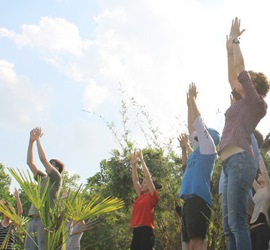
It has a diverse set of practices that coordinate body, breath and mind. Practices include moving and static meditation, massage, chanting, and sound meditation. Movements might be dynamic with slow flowing movements or passive, meditations with inner movement of the breath. Some practices emphasize static postures held for long periods of time.

With roots in ancient Chinese culture dating back more than 4,000 years, Qi Gong is practised for health and long life, as meditation, and to enhance skills in martial arts.

Qi Gong has many different lineages although in modern times attempts have been made to draw them together. Influences range from Dao and Confucius, to Buddhist strands that would have brought influences from the sub-continent of India, home of yoga.

Traditionally, knowledge about Qi Gong was passed from adept master to student in elite unbroken lineages, typically with secretive and esoteric traditions of training and oral transmission - just like yoga!

The name literally translates as "life energy cultivation". The concept of "qi" or "chi" is similar to the yogic concept of "prana", that is, it is a life-force energy, and like prana, qi flows throughout everything. Health, longevity and spiritual advancement depend upon free flowing and masterfully controlled qi.

The movements themselves may be very different from those we know in yoga, but the practices are somatic, with great mindfulness of the felt sense of the body. The breath also has a place of high importance in Qi Gong. Meditation and relaxation as a pathway to wellbeing are also important. So yogis will certainly find an affinity with the practice.

At Yoga Spirit Studios we remain curious about all somatic practices and pathways to wellbeing, so we were very pleased that a teacher of Qi Gong could come to the studio to teach some Qi Gong.

Secret Elements Qi Gong combines these ancient roots with the modern knowledge of kinesiology and psychology. According to Secret Elements co-founder and trainer Sascha Wagener the system is easy and can be learned by anyone.  It can be practised standing, seated or even lying. The secret to the power of these movements is in developing a deeper awareness of the body moving, and the process deepens with each practice. (Still sounds like yoga?)

This can benefit anyone, if you are recovering from illness, ageing, an athlete or a business person, anyone," says Sascha.

Wednesday, May 20, 2015

Cultivating right attitudes

First published in "on the Mat", the newsletter of Yoga Spirit Studios

Switching on the news can be quite depressing can't it? We should ensure we are informed about what is happening in our world, hiding our heads in the sand will not help. But there is so much violence, and so many people swept up in terror, death and destruction. I find myself very moved by it and frustrated too that as individuals we can do nothing to change it.
What we can do is cultivate the right attitudes in our own heart, ensure that we are wiring our own brains towards non-violence.

Non-violence, or ahimsa is the first practice that Patanjali offers in the Yoga Sutras, the very first of the yamas, which is the first of the eight limbs of yoga he lays out in Book 2, the Book on Practice.

However today I am drawn by a sutra in Book 1, sutra 33.

The mind becomes quiet when it cultivates
friendliness in the presence of happiness, 
active compassion in the presence of unhappiness, 
joy in the presence of virtue 
and indifference toward error

Sounds easy enough. But is it? In this sutra we are being given the clue to much needed equanimity in the face of all we meet, equanimity that will guide us into right action to fulfill our responsibilities.

Friendliness in the face of happiness: Sometimes another's success serves to remind us of our own failings and this may set our minds in an unfriendly direction. cultivate friendliness. Note the feelings of unfriendliness if they arise, invite it in, and then also invite friendliness. Move back and forwards between them. You will find that the unfriendliness loosens its grip upon you and you have cultivated friendliness.

Active compassion in the presence of unhappiness: It is relatively easy to be compassionate in the face of a friend's bereavement but what about the unhappiness of a homeless person, or a drunk or drug addict. Faced with the homeless person, drunk or drug addict, right there in front of us, do we feel compassion or aversion? First we can note that tendency, but then can we open ourselves to be with the other's suffering, acknowledging our oneness?

Joy in the presence of virtue: Is there a contraction present when we see the good works of others, perhaps because we feel ourselves to be unworthy or incapable of such giving? Note that. Then can we cultivate, feel its opposite as joy?

Indifference towards error: Why indifference? Does that mean we should not act when error is present, as in the bombing of children or passenger planes? The lesson here is to note the passion, the sadness, the anger, and the sense of impotence that arises in the face of error, note it and welcome it, and then chose equanimity, (indifference) as its opposite and cultivate that. Then we can act from the correct place, we can respond rather than react.

So much of the ever spiralling vortices of violence we see are fuelled by unskillful reaction based on hatred and fear. Patanjali offers another way and what better place to start than with ourselves, where we can act to make a change.

Wednesday, May 13, 2015

Packing for a yoga workshop


First published in "On the Mat", the newsletter of Yoga Spirit Studios.


During a training I recently attended, my buddies were amused and amazed at the things I had brought along to keep myself comfortable. They asked for my packing list. So this is for all of you, but especially for Lizzie, Susannah, Anna and Bev!

When you are going away on a yoga retreat or training, chances are you will need to bring along your own gear. This is tricky, especially if you have to travel by air. So rule number one is to always make sure your ticket will include a checked bag for your yoga gear.

Some time ago I bought a large wheelie duffel bag especially for the purpose and have never regretted it. Usually, most of my clothes will fit into a carry-on bag, leaving the checked bag bag for my yoga gear. The first picture shows my bag with only my yoga gear in it, and there is still room for a few clothes or toiletries that don't fit in the carry on.

Into it I pack a bolster, a sticky mat, one blanket, a block if it is an asana retreat/training and a meditation cushion. On this last trip I also borrowed a little camping seat which was so useful I have now ordered myself one online - they are sometimes available in camping stores but never when I go looking. I also pack a little bag of extra bits that I use in my practice. It contains a super-ball for rolling my feet on, two flannels for fine tuning of restorative poses, a strap, a rolled up towel to make a "sushi-roll" for selfie back massages, a hand fan for when the room gets too hot, an inflatable gertie ball for all manner of releases, my still-pointer balls for a quick relax, yoga toe socks and sticky wedge gloves (could stay in my room for a matless practice when needed) an eye-pillow, two silk sarongs, useful for a little extra warmth during relaxation or when the air conditioning is too chilly. If it is winter time I would probably also stuff my zebra stripe snuggie in too, perfect for a toasty relaxation. If you are going to a workshop with Donna Farhi, count on packing a large bath towel as well for the famed "wonton head wrap". I also have an inflatable bolster that I might also pop in if I thought a second bolster would be good to have.

It’s all about being prepared.


Thursday, May 7, 2015

Navigating Asteya in modern life

Asteya, it's the third yama, the five constraints or external ethical practices recommended by Patanjali as the first of the eight limbs of yoga.

"Steya" is to take something that doesn't belong to you, that is to steal. "Asteya" is the opposite, not stealing, avoiding anything that could remove from someone else what is rightfully theirs.


First reaction - oh that's easy, I'm not a thief. Meaning, I don't break into houses, steal cars, shoplift, or create email scams to do people out of their money. OK, so how do you do on these questions?

Do you only ever pay for music that you like to listen to, or do you think its OK to take a friend's CD and download it to your device?

Are you one of those downloading Game of Thrones?

Would your default position be to try to get concession tickets you are not entitled to instead of paying full price? Would you get your six year old into the show as an under five year old for free?

Or even trickier .....

Do you turn up to events on time, or is it OK to you to be late and thus steal the time of others?

Perhaps you never even thought of it that way. But as we begin to really consider the depths of this undertaking of Asteya, we discover that there are many ways that we may be prone to "steya" that are not crimes, like turning up late.

This third yama, so easy to commit to at first sight, actually leads us into deep self-examination. For example, do the products I purchase result in damage to the planet and the stealing of habitat of other creatures, or were they produced with slave labour, stealing the right for a free and healthy life from other people? It is really complex and a life-long undertaking, if we truly try to practise Asteya, but isn't all of yoga deeper and life-long when we really start to embrace it?

Our modern life certainly makes it difficult. For a start, desire is the root cause of stealing. Therefore if we can overcome desire, Asteya follows.  With desire comes a sense of entitlement and we convince ourselves that the world owes us in some way. If others have more than me, then they will not miss what I am taking.

Our economy is based upon creating desire in us so that we consume more. The sophisticated marketplace that is enticing us everywhere we go is persuading us to want more. And the ways in which products may be stealing (habitat, lifestyle, income and so on) can be quite masked behind seductive gleam. Furthermore we live in a world in which technology makes it so easy to download and copy that which is not ours.

Yet we can all make a start, make a commitment to try, and begin to examine what we do in the light of Asteya.

Discussing ethical issues is helpful in developing our ethical sensibilities. Would you like to discuss this? Use Comments to share your thoughts on practising Asteya in daily life.

Saturday, April 4, 2015

The Egg


As it is Easter I have been reflecting on all things Easter. Naturally eggs came up. I have always wondered about the place of eggs in the Easter story. A Sunday School teacher once told me it is to represent the stone that was rolled away from the tomb. Others naturally point to its new life symbolism, and that Christ's resurrection is a new life and it offers us a new life too.

The egg is a symbol that occurs across many faiths and traditions, often featuring in cosmology or stories of creation as well. It seems to come into the Christian tradition from earlier practices, reinterpreted. Red stained eggs, to symbolise the blood of Christ, were used in the early Eastern church, and there are stories that accompany this. But we know that coloured and decorated eggs were also features of other and earlier societies as well, including in the ancient Indian Vedas, the source of yoga itself.

The Brahmanda is the "cosmic egg", the totality of the universe. "Brahm" means "cosmos", "expanding", "biggest" and "creator". "Anda" means "egg" (pronounced with a long first a - aanda). The cosmos is conceived of as a giant egg, a giant, expanding egg.

This has a rather lovely resonance with modern scientific cosmology.We now know that the universe is indeed expanding, knowledge which came out of Einstein's theory of general relativity, predicted by Alexander Friedmann and observed by Edwin Hubble, There is also the notion that there was at some time a point of singularity, a minuscule gravitational dot out which the expanding universe arose, expanding in all directions, and continuing to do so. In the Vedas that would be called the "bindu", or it might be the "anda" at its smallest.

Science has yet to offer an explanation for the big bang that set all this expanding off.

Brahmanda is seen as simultaneously the bindu, source of all, and the macrocosm, all that is manifest. The manifest arises out of and within the whole, which is Universal Consciousness, Awareness. Yoga's goal, the union that is right there in the name "yoga", is our ultimate recognition of our being one with that Universal Consciousness.

So the egg in yoga can also symbolise a new life, awake to the full grace of Awareness.

Hari Om Tat Sat.


Tuesday, March 3, 2015

Patience, perseverance, optimism and faith

Ram Dass wrote in his book Be here, now: "If you think you are enlightened, go and visit your family." The message is that the road is long and the potholes many if we are applying ourselves to our personal growth, the spiritual journey.

I often disappoint myself! Just when I think I am making progress, peeling off the layers of conditioning and learning to respond from the supportive home ground of Being, I bump up against my limitations and I react. Rats!

No point in cursing. I just have to welcome the limitation and get back to the meditation, and practise, practise, practise. Keep on dipping into Awareness, practising meeting what arises with welcoming, and repeating the heartfelt desire expressing that I am not limited by all of that conditioning.

I remain hopeful and am grateful for the fabulous tools that yoga teaches us. It can take some time to find the tools that will resonate for our unique vibration. I am also grateful that I have found the tools of iRest® Yoga Nidra, with its core principles of Well-being, Welcoming and Witnessing Awareness, and its delectable practises.

Your path may be different. Yours might be fishing or walking and the meditative experience that gives you! Whatever our path, at the end of the day we need patience, perseverance and optimism to stay the course.  We might fall off, but we can always jump back on.

We also need faith.  Not blind faith, but faith that we do have the tools that will serve us well and guide us home. I wish you all faith in your path. Om shanthi.